Written in July 2026.
An infrared camera has been sitting in my car for two weeks.
I put it there one morning in early July, for an image I had wanted to make for months, in a local wood that nobody much visits except dog walkers. I picked the camera up without any hesitation at all. Whatever happened later that morning, it had not arrived yet. It was waiting for me at the wood.
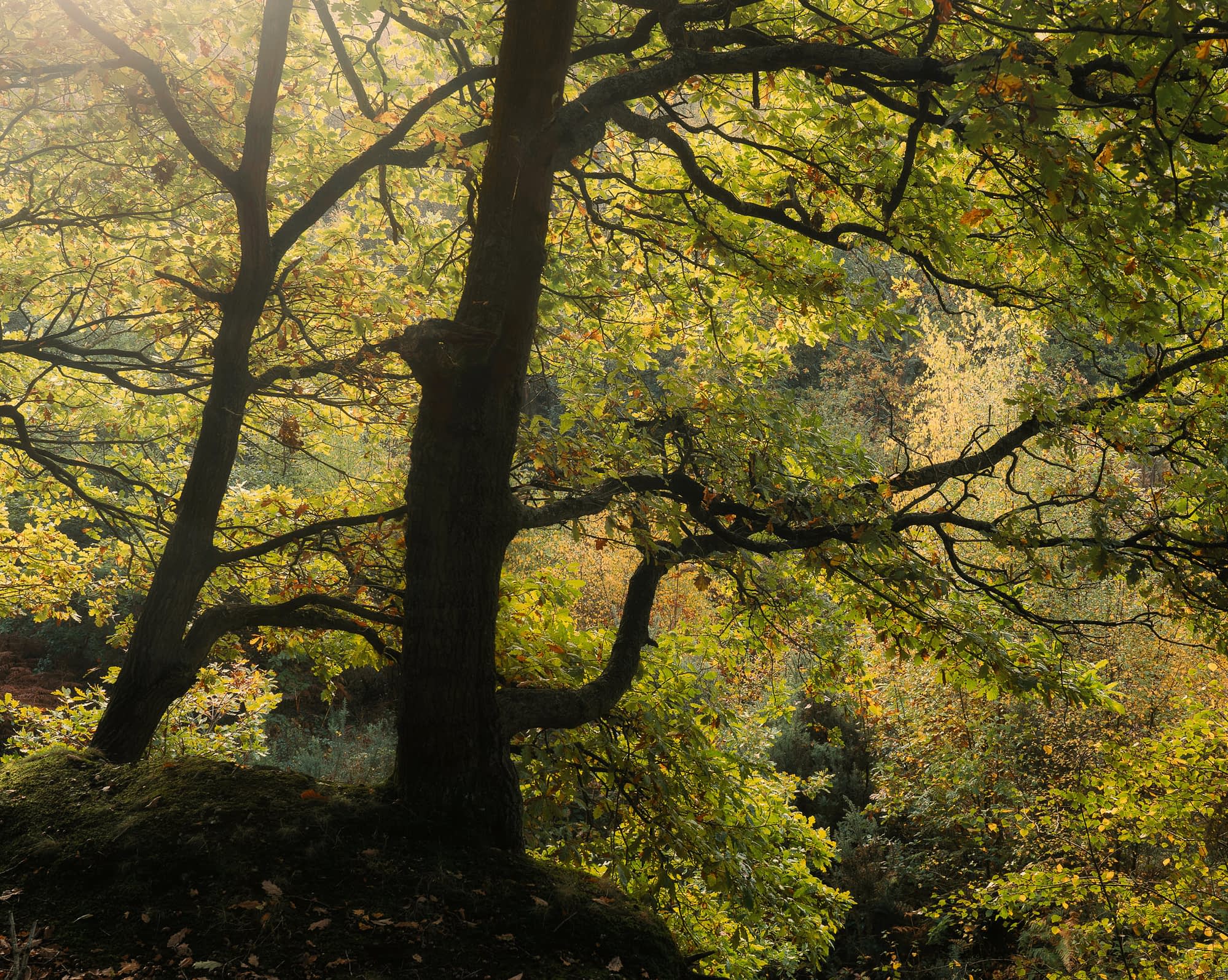
The image was to be the missing frame of a long relationship. At the edge of that wood, on a low mound of moss, stand two oaks I have been returning to for years, the kind of return I described in Farming Compositions.
I have photographed them under snow with the last of their autumn leaves still holding on. In winter fog, bare to the bone. In spring and summer green, in the first turn of autumn, in mist with the sun breaking through in rays. Seven frames so far. One register missing from the set: the hard, unbroken light of a summer midday, the light every other frame politely avoids, and the light my infrared camera is built for.
So the plan was sound. Better than sound: it had been designed, without my quite admitting it, to be excuse-proof. No early start, and summer early starts are the ones that cost me most. No golden hour, no fog forecast, no waiting on the weather apps. Midday, harsh sun, a camera that thrives on exactly that, a subject I already knew frame by frame.
I drove past the trees and did not stop.
The sun was moving in and out of cloud, and I told myself the light was not settled enough. There was some truth in it. Infrared wants the sun full and constant, and it kept arriving and leaving. But I have worked in worse and waited out less promising skies. I knew it was an excuse at roughly the moment I was making it. That is a strange thing to know about yourself in real time, and it changed nothing.
I parked in the car park and sat for half an hour, watching the light come and go through the windscreen, waiting to feel like the person who gets out of the car. Then I drove past the trees a second time. Thought about turning around. Turned around. Drove past a third time, and went home.
I did not make the image. I did not take the walk either. Two weeks on, the camera is still in the car.
Here is the detail I keep returning to. There is a verge close to the trees where people used to pull in and park, and it has recently been blocked off. Correctly blocked off, I should say. It was never meant to be parking. But my plan, if I am honest about it, had leaned on that verge.
Slot in beside the trees, make the image quickly, retreat.
An outing with no walk in it at all.
With the verge closed, the morning suddenly asked a few hundred metres of me on foot, from the car park or from the road further up. That was the whole demand. A few hundred metres, and I drove home.
The unsettling part is not that the answer was no. The unsettling part is that the question existed. Is this image worth a walk?
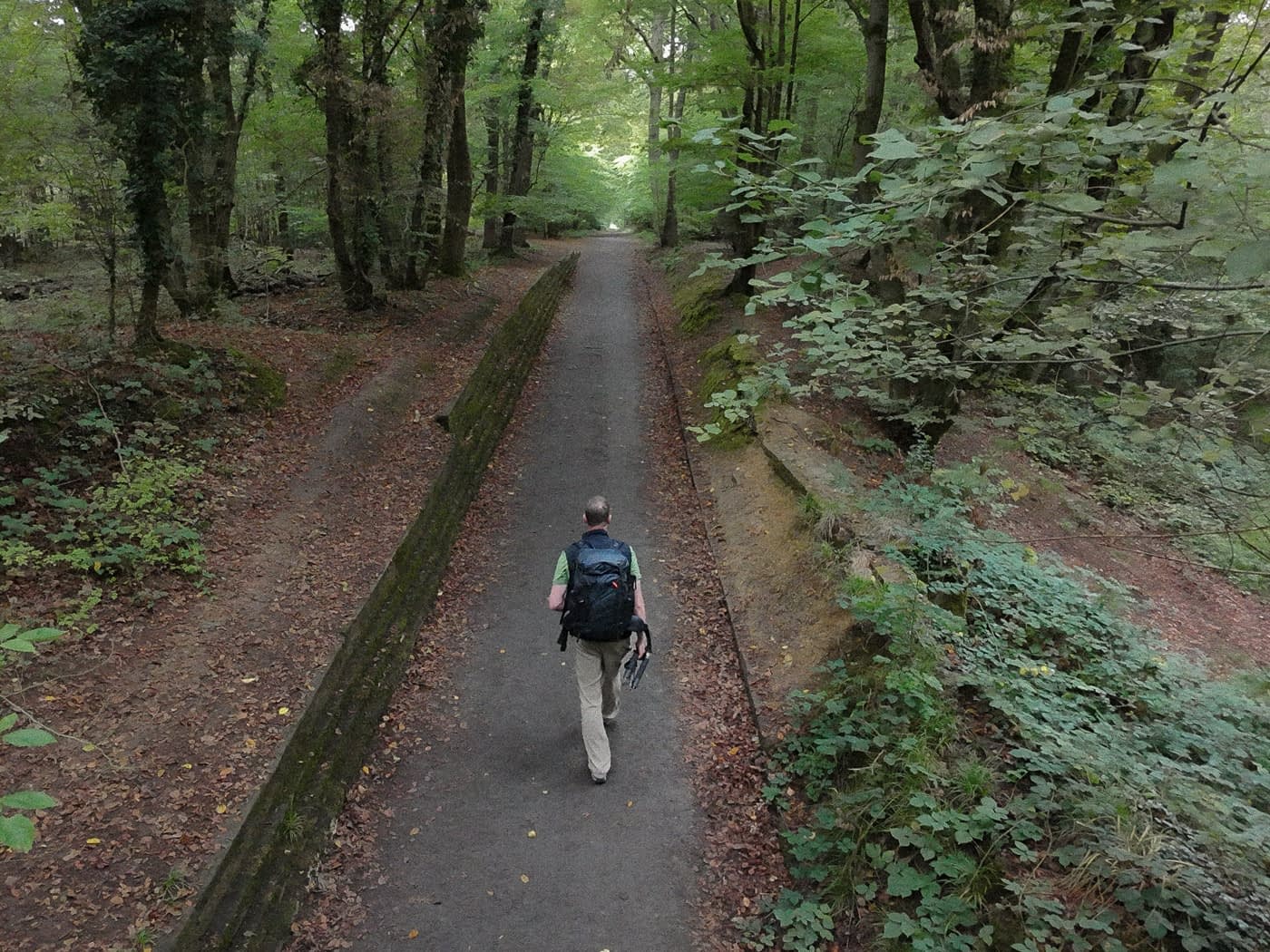
A few years ago that sentence would not have parsed. The walk was the point, and the image was what the walk happened to produce. I wrote it plainly enough earlier this month, in The Photograph That Doesn't Exist: my primary activity, if I am honest, is going for a walk, and I just happen to take a camera and tripod along.
I believed it when I wrote it, and I believe it now, as a description of the practice I built. What I have had to sit with since that morning is a harder question. When was it last simply true?
I went looking for the answer. The last time I can honestly place a walk in the woods where the walk was the thing, no set to finish, no image in mind, the camera along only because my hands expect it, was more than two years ago. Before I was seriously ill.
I am careful about how much of that story I tell, and this is not the essay for it. What matters here is the arithmetic the illness left behind. I can still do the long days. A recent workshop ran sixteen hours on our feet from a four in the morning start, and it was a productive day for my client and for me. But the bill for a day like that arrives afterwards, over several days, and I pay it.
My legs are still rebuilding, and legs that are rebuilding keep accounts. None of this stops the work. It means that somewhere below the surface, every walk now has a cost column, and some part of me is always doing the sums.
Which quietly rewrites an arrangement I had never needed to examine. When walking costs nothing, the camera is the excuse for the walk. The photograph gives the wandering a shape and a direction, and asks nothing back. But when the walk has to be paid for, the excuse changes jobs without telling you.
The image stops being the pretext and becomes the justification. A walk with a photograph at the end of it is easier to authorise than a walk with nothing to show. And so, somewhere in two years of recovery and rebuilding, without a single decision being made, I stopped going to the woods for walks and started going to the woods for images.
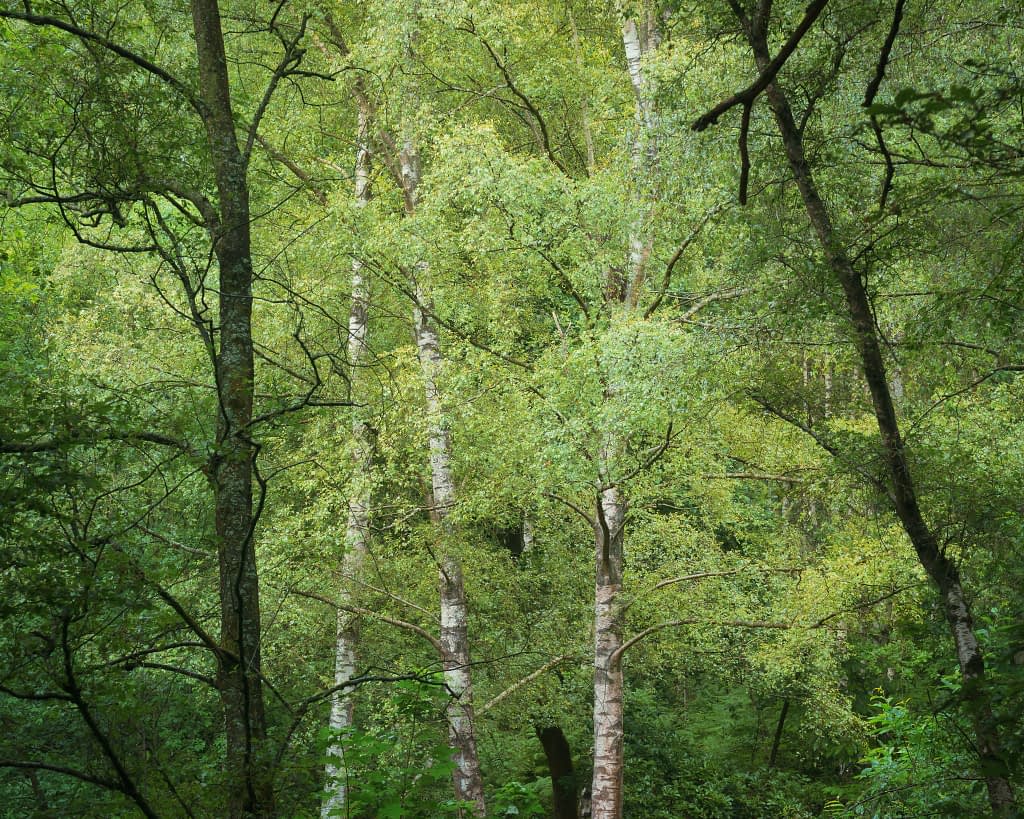
The reversed arrangement works. That is the trouble with it. This spring was lovely and productive: bluebells, new leaves, birdsong, the woods putting on a show that pulled me out of the door with no accounting required. The client work has delivered all year. Judged by its output, the practice is missing nothing. That is precisely how the walk went missing unnoticed. The images kept arriving, the jar still filling, and the images were what the walk was supposed to be the excuse for, so nothing reported the loss.
So the morning in the car park reads differently to me now than it did at the time.
I had gone out, in my own worst phrase, to collect a view.
That the view was two oaks in an unremarkable wood, a view I had spent years earning, does not change what the errand was. And when the errand met resistance, marginal light, a closed verge, a few hundred metres on foot, there was nothing underneath it to hold me there. The older arrangement would have shrugged and gone for the walk; the images were never the reason.
The newer arrangement did the sums and drove home.
Or perhaps even that is too neat. The explanation I keep circling is the one that arrived last: perhaps the mind was calculating that the walk was not for the legs that day, and the story about the light was what it handed me to read while it worked. I notice that this explanation turned up two weeks late.
I notice I keep saying perhaps.
There were other candidates that morning too. My head was full of a coming trip and a list of unresolved things, and a full mind quiets the seeing faster than any weather. Each explanation is plausible. None of them quite settles it. The honest version may be that the mind was weighing something that morning, and all I was shown was the verdict.
In a few weeks I will be in Canada, and I am hoping the time away reminds me of something. The joy of making pictures, maybe, if that is the thing that is missing. It may not be.
What I have instead of a plan is a suspicion about the order in which things return. The photographs never stopped; they have been arriving all year, productive and publishable. The walk stopped. If one of them has to come back first, I do not think it is the one I have spent two years being productive about.
The camera can come along. It always has. But it has to go back to being the excuse. And for that, there has to be a walk again for it to be the excuse for.
If your practice has drifted somewhere you did not choose, and you would rather sit with that honestly than push through it, my free Mindful Photography Prompts are built for that kind of sitting. A few questions for before you go out, and a few for after you come back. Quiet ones.