Choosing the best focal length for woodland photography can feel overwhelming at first. Go too wide and everything feels chaotic. Zoom in too far and you lose the character of the place. It’s a tricky balance that many photographers struggle with, especially in complex, ever-changing environments.
Trees stretch in every direction. Light moves constantly. Texture and detail are everywhere. But with the right focal length and a little patience, you can bring order to the mess and find clarity in the chaos.
This guide is shaped by years of walking in local woods, framing scenes with nothing but a composition window and my eyes before I even reach for the camera. I’ve shot everything from ultra-wide to long telephoto, but over time I’ve returned to a few key focal length ranges that feel natural to me.
Whether you’re just starting out or looking to refine your approach, this article will help you understand how focal length shapes what you see and how it influences the kinds of woodland photographs you make.
Want a practical next step? Download my free guide, Taming The Chaos: The Key to Better Woodland Photography Compositions, and start seeing the forest with fresh eyes.
Table of Contents
Why Focal Length Matters in Woodland Photography
Focal length plays a huge role in how we experience and photograph the forest. It affects how we interpret space, depth, and energy within the frame. It's not just about how close or far the subject appears.
When I started photographing woodlands, I defaulted to wide-angle lenses. I loved the immersive feel. But I also ended up with chaos. Branches jutting in from the edge. Distracting highlights. Compositions that looked better in person than they did in-camera.
What I didn’t realise at the time was how different focal lengths subtly guide the viewer’s eye. Wider angles exaggerate depth and perspective. That can work if the scene has strong structure, with a defined subject and a clear visual flow. But most woods aren’t that tidy. They sprawl in all directions and overwhelm the frame.
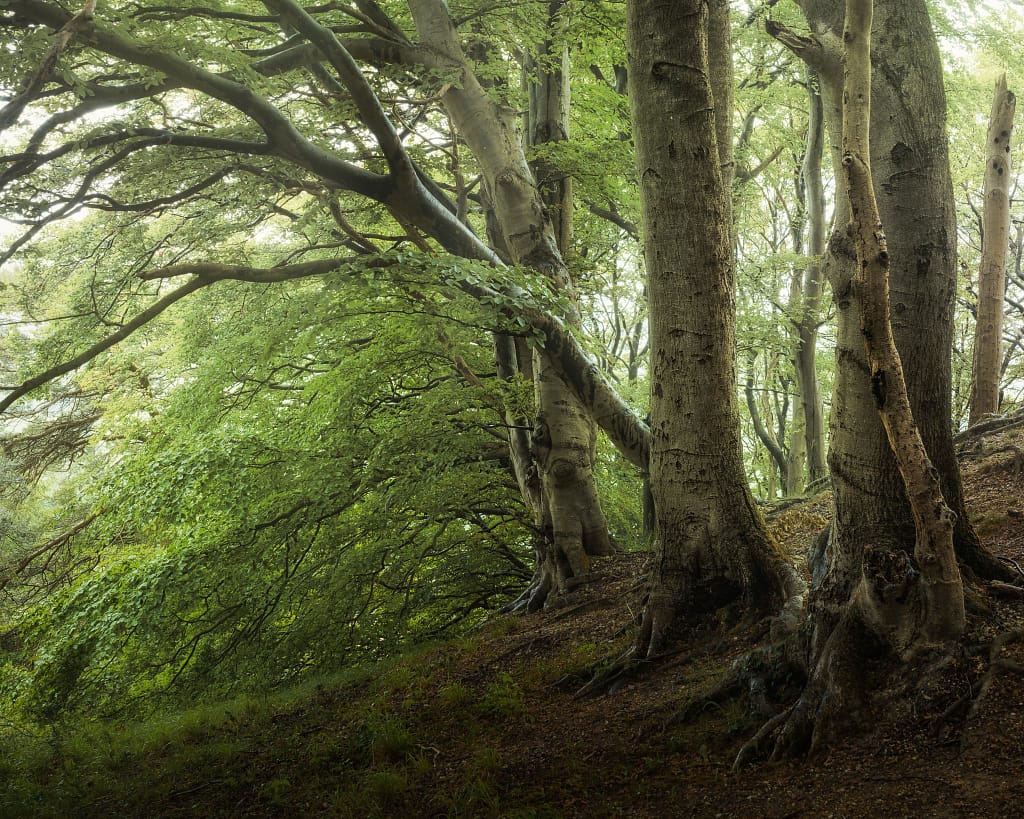
While I do sometimes reach for longer focal lengths, I tend to do most of my woodland photography between 40mm and 85mm. That range just feels natural to me. It strikes a balance between including enough context and simplifying the scene. I often photograph groups of trees rather than isolated ones. Many of my favourite images come from wider forest views with a touch of intimacy, where the lens perspective aligns with the way I see.
Using focal lengths like 50mm or 70mm lets me frame those quieter compositions. Maybe the light hits a cluster of trunks just right, or there’s a gentle interaction between trees that only becomes visible when you narrow the field of view. I find that background separation at these focal lengths is still strong enough to simplify busy woodland scenes, especially when there's mist or soft side light.
If you're curious what I mean, take a look at the images in my British Woodland gallery. Many were composed in that mid-range sweet spot. Not too wide. Not too tight. These images show how effective this focal length range can be when simplifying forest scenes and revealing the rhythm of the trees.
If you're struggling with shooting in cluttered environments, don’t blame the location. Try adjusting your focal length. That change alone can help bring clarity and intention to your forest composition. You might also find my woodland photography composition guide helpful for understanding subject balance, depth, and how to use focal length for stronger storytelling in woodland photography.
Common Woodland Focal Length Ranges Explained
Wide Angle (16–35mm)
Wide angle lenses, typically between 16mm and 35mm, can be a tempting choice when you first start exploring the woods with a camera. They offer an immersive feel that draws the viewer into the scene. This focal length range exaggerates depth, emphasises scale, and includes more of the forest environment. When used carefully, it can be one of the best focal lengths for woodland photography, especially if you're aiming to convey a sense of atmosphere or place.
I sometimes reach for the wider end, around 18mm to 24mm, when I’m photographing in fog or heavy mist. These conditions naturally simplify woodland scenes, making it easier to avoid the usual problems of shooting in cluttered environments. There’s something about trees fading into the distance that works beautifully at wide focal lengths. If you're interested in how weather affects the scene, take a look at my guide to the best weather for woodland photography.
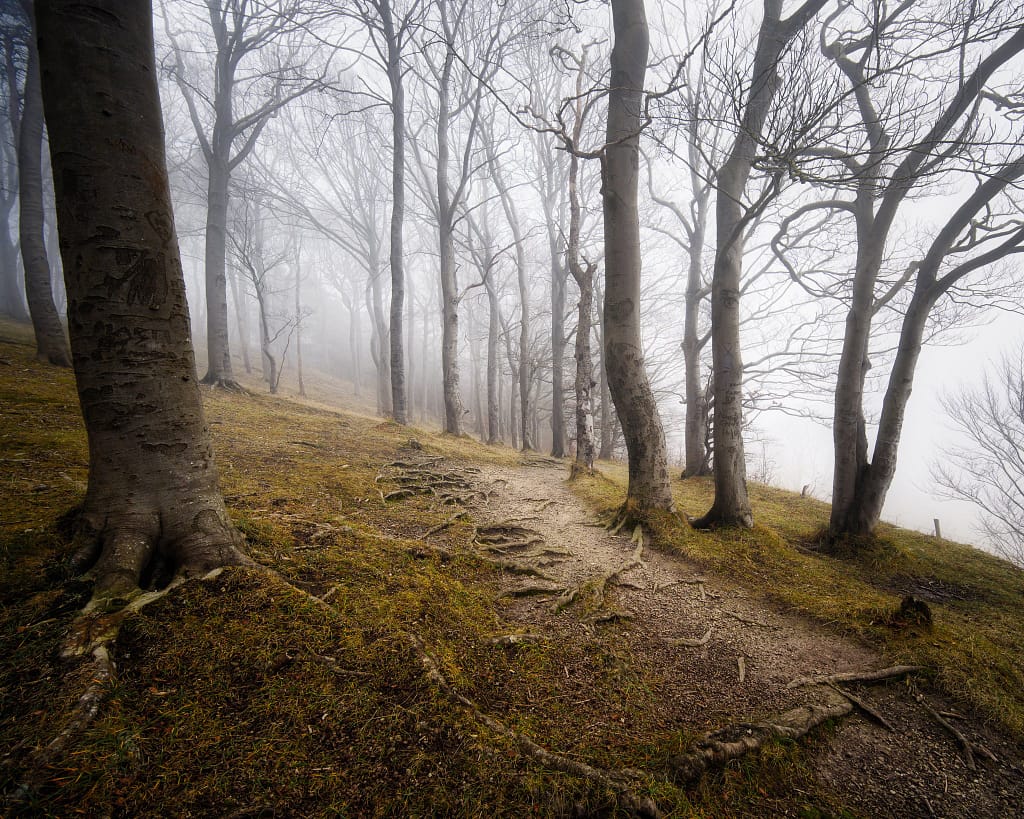
Wide angle compositions also work well when you find strong shapes or leading lines - perhaps an ancient tree with arching limbs or a path curving through the woods. These elements can anchor the frame and help you simplify the scene.
But this focal range includes a lot. You often end up with stray branches at the edges or busy backgrounds that distract from the subject. Simplifying wide-angle woodland photos takes care and usually means shifting your position by small amounts to get everything in the right place.
This focal length range works best when the conditions do some of the heavy lifting (like mist, strong light or bold shapes). Without those, wide-angle woodland photography often feels more frustrating than rewarding.
Standard (35–70mm)
Focal lengths in the 35–70mm range are where I feel most comfortable. This standard lens range offers a natural perspective that closely matches how we see the forest with our own eyes. It’s one of the best focal lengths for woodland photography when you’re looking to strike a balance between showing the environment and simplifying the scene.
I probably shoot more woodland photos around 40–50mm than any other focal length. It gives me just enough compression to clean up distracting backgrounds while maintaining the context of the woods. 40mm feels more immersive, while 70mm offers a more intimate view. For forest scenes with a few strong shapes or subtle layers, this range gives me the flexibility to frame without overcomplicating the image.
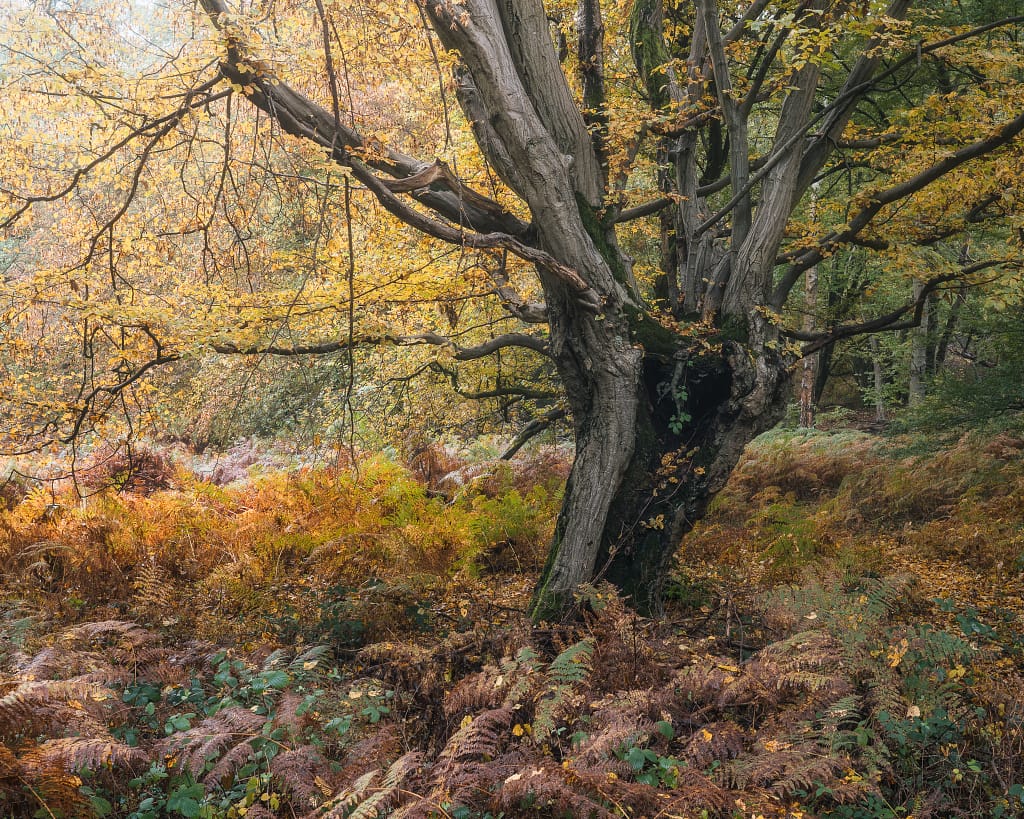
This focal length range is particularly useful in mist, soft morning light or light rain. These are situations where background separation happens naturally. I often find myself composing with just a few tree trunks interacting or catching the light. When that relationship is subtle, a standard lens can reveal it without exaggerating or flattening the scene. The result is often a quiet, contemplative image that feels true to the woodland experience.
Some of my favourite photos come from this range. They’re not about drama or scale, but about rhythm and flow: the way branches echo each other or the way light filters through layers. The forest feels approachable here. Balanced. Honest. If you're interested in how light transforms a scene in this focal range, have a look at my guide to light and shadows in woodland photography.
Of course, not every forest scene suits this approach. Sometimes there’s too much clutter or not enough structure. In those cases, switching to a slightly longer focal length can help you simplify the scene or isolate your subject. That’s where understanding how focal length influences mood and composition becomes a valuable part of your toolkit.
Short Telephoto (70–135mm)
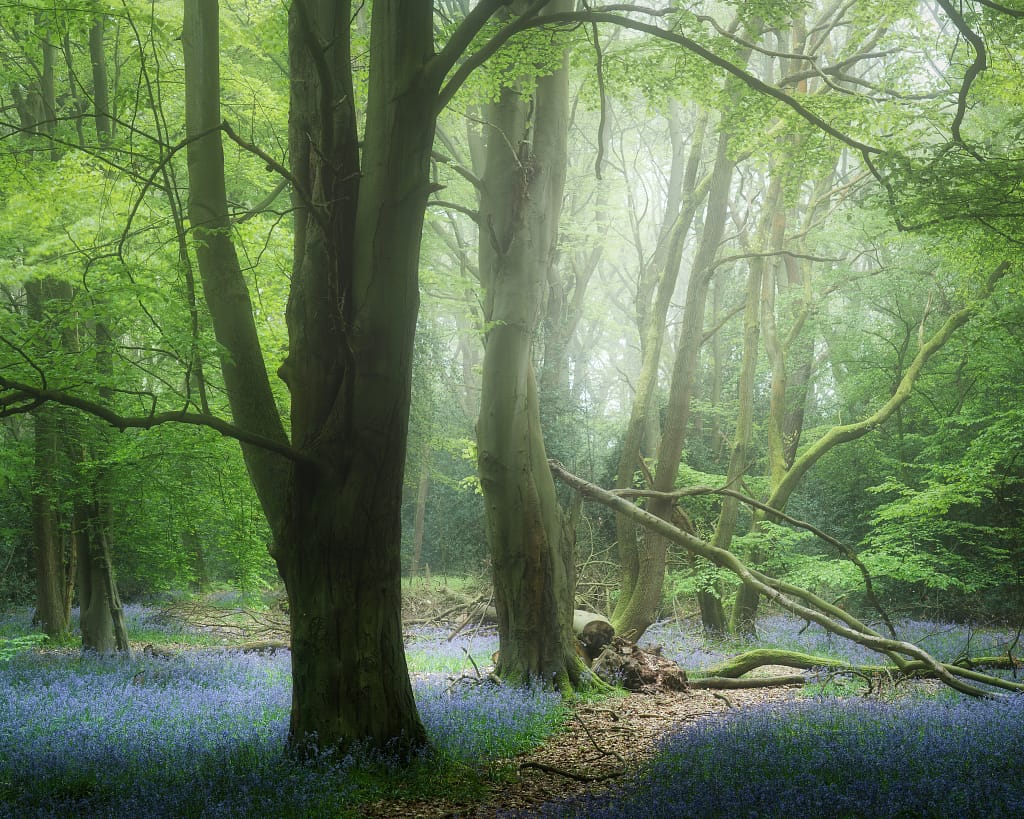
Short telephoto focal lengths between 70mm and 135mm are among the most useful options when thinking about the best focal length for woodland photography. This range gives you more control over composition and allows you to isolate elements without cutting them off entirely from their environment. It’s ideal when you're trying to simplify cluttered forest scenes or emphasise depth and rhythm in tree arrangements.
I often reach for this focal length range when something catches my eye, but the wider context doesn’t work. Around 85mm to 105mm is where I seem to land most. It gives me enough lens compression to reduce background distractions and bring order to the frame without making it feel flat. It's also the range I use when photographing trees that are slightly further away but still connected to the surrounding woodland.
There’s a certain kind of intimacy that comes from shooting at 105mm in the woods. I might notice a gentle bend in a branch or the way the trunks echo each other at an angle. These quiet gestures are easy to miss with a wider lens. The short telephoto range lets me get closer emotionally, even if I’m standing several paces back.
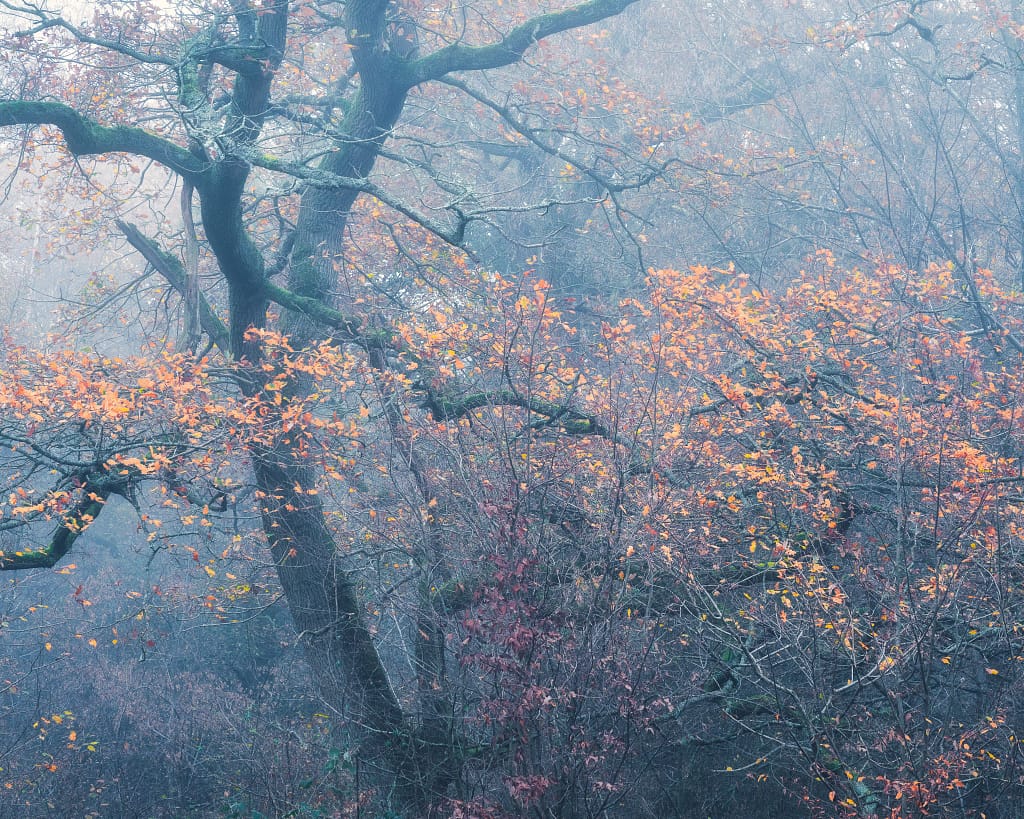
This focal length is also one of the best for woodland photography when you want subject-background separation but still want to maintain a natural, honest look. I’ve found it especially helpful in soft light, such as early morning fog, light rain, or overcast conditions. In those moments, the subtle tones and tree shapes can be brought to life more clearly using this focal range.
A zoom lens that covers this short telephoto range can be a powerful tool in the forest. Not because you need to zoom constantly, but because it allows you to dial in the exact focal length that matches how you saw the scene. If your natural way of seeing involves tighter frames or isolating tree details, this might be the focal range you return to most often.
Long Telephoto (135–200mm and beyond)
Long telephoto focal lengths, typically from 135mm and up, can be one of the best focal lengths for woodland photography when used with care. While they’re not my everyday choice, I keep returning to them for moments when compression and distance add something unique to the image.
I tend to reach for a telephoto lens in the woods when I spot something intriguing from afar, such as a glowing tree catching the morning light or a cluster of trunks that look perfectly spaced when viewed across a valley. Shooting at 160mm or 200mm lets me isolate these visual moments without physically entering the scene. It’s a powerful way to simplify forest compositions and direct attention exactly where you want it.
This lens range offers strong compression. It flattens space just enough to help with background separation, which can be a game-changer in cluttered environments. Instead of having dozens of overlapping branches, a longer focal length allows you to control the scene and remove chaos.
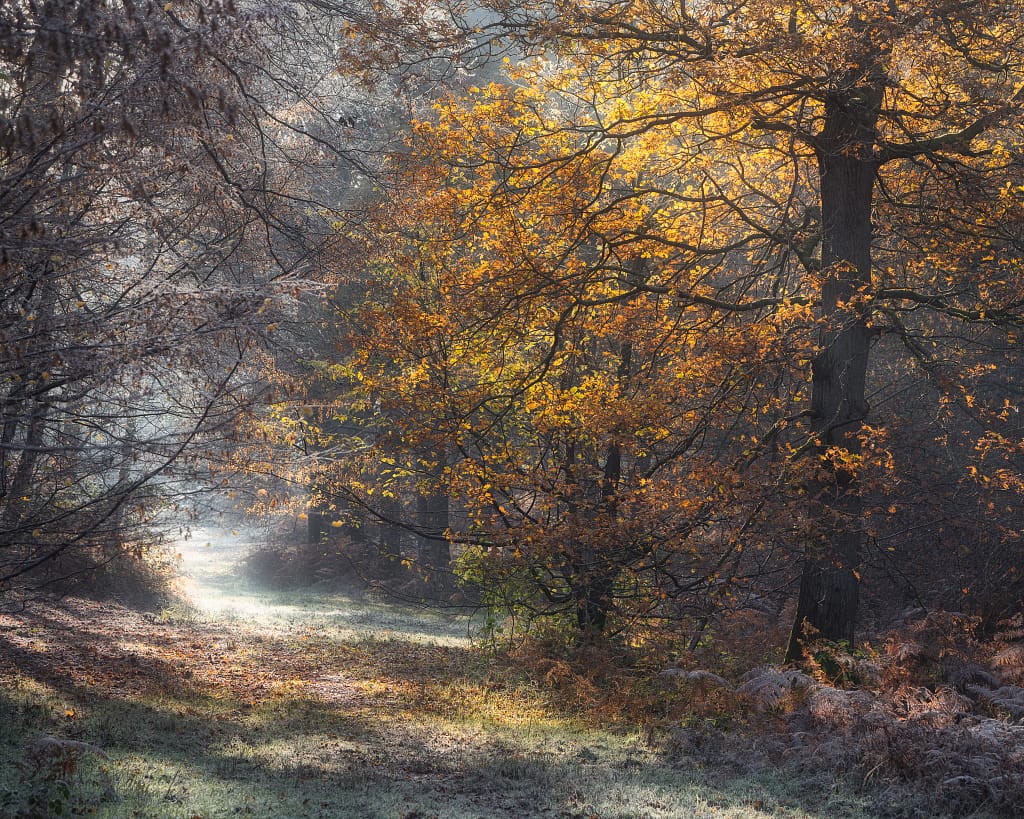
That said, compositions at this focal length are hard-won. The narrow field of view means small changes in position make a big difference. I’ve spent whole mornings adjusting by a foot or two just to avoid a branch crossing through the frame. It's slow work, but that’s often where the strongest woodland photographs come from: patience and precision.
Using a long lens for woodland shots also invites a different kind of seeing. You’re not reacting to what’s around you. You’re scanning for relationships (shapes, lines and gestures) that only appear at distance. It's a contemplative process, more about noticing than chasing.
When I use a lens like a 200mm in the woods, it’s because I’ve already seen something worth framing. I’m not hoping to stumble across a composition. I’m seeking out quiet interactions between trees and building the image with care.
If you’ve never explored this range in the forest, give it a try on a misty morning or a day with soft light. Conditions like these enhance the effects of lens compression and background separation, helping the subject stand out in a natural, unforced way. This is where a telephoto lens truly comes into its own in woodland photography.
My Favourite Focal Lengths for Woodland Photography
Some focal lengths just feel right. I keep coming back to 40–50mm, 75–85mm and 110–135mm. Not because of any rule, but because they suit the way I naturally see when photographing woodlands.
Before I even think about lifting my camera, I slow down and observe. Sometimes I’ll use a View Catcher or even my fingers to frame the scene. If something clicks, I’ll mentally note the right focal length to recreate what I saw. And more often than not, it falls within one of those three ranges.
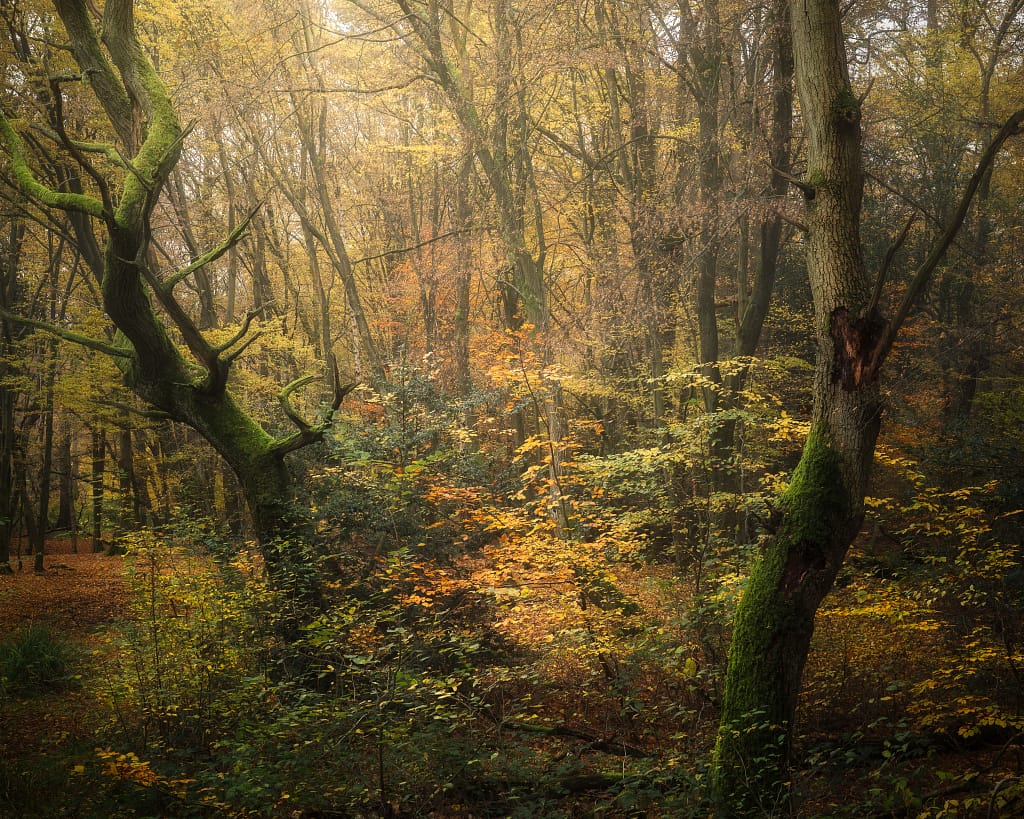
This process helps me stay focused on what matters. I'm not reacting to gear or chasing focal lengths for the sake of variety. I'm responding to a visual moment in the woods. That’s a big part of what makes woodland photography feel meaningful to me.
The 40–50mm range gives a natural, grounded view. It lets you include enough of the scene without things getting messy. When I move into the 75–85mm range, I can start reducing clutter and creating more separation between elements. And with 110–135mm, I find it easier to simplify chaos, isolate rhythm in the trees, and carve order out of dense forest backgrounds.
These aren't just my go-to ranges in one season. I use them all year round, depending on how the woodland is structured and how I’m seeing on that particular day. Not every wood responds well to them, and that’s fine. The key is learning how focal length helps you create clarity, and knowing when to switch things up.
Want to see how these focal lengths work in real scenes? Take a look at my British Woodland portfolio. You’ll notice a strong pattern. These aren't just numbers on a lens; they’re the tools I return to because they help me simplify woodland compositions and photograph what I actually saw.
How to Choose the Right Lens for Your Woodland Shoots
Ask yourself: What story am I trying to tell in this forest scene? That question shapes everything. Are you trying to capture the atmosphere of the woods, the quiet rhythm between trees, or a specific feeling that stopped you in your tracks? Once you’re clear on your intent, choosing the best focal length for woodland photography becomes much easier.
I often commit to one focal length for the whole walk. Not as a limitation, but because it mirrors the way I saw the scene in the first place. Before I take out the camera, I slow down and visualise. I use a View Catcher or a simple framing window to explore compositions with my eyes. If something resonates, I make a note of where I stood and which focal length best matches what I saw. Only then do I unpack the gear.
This keeps my process grounded in seeing, not just shooting. When I use a consistent focal length in the woods, my photographs tend to feel more intentional and cohesive. I’m responding to the structure and feel of the woodland rather than second-guessing myself.
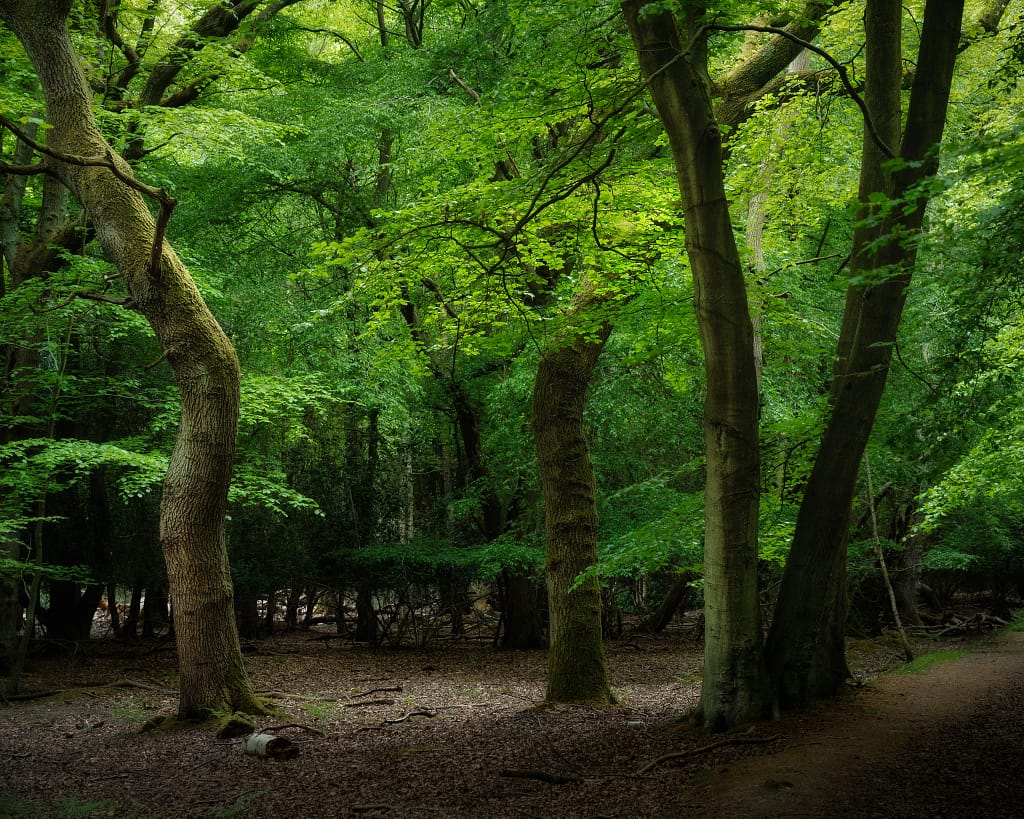
Zooming in and out without purpose often breaks that connection. It turns photography into a mechanical process rather than a creative one. I’ve lost count of the number of times I disrupted a promising moment by fiddling with focal lengths instead of responding to the composition that was already in front of me.
That’s why I prefer zoom lenses for woodland photography. Not because I want to cover every focal length, but because I can dial in the precise perspective that aligns with what I saw before even lifting the camera. I still use the zoom as if it were a prime lens. I choose my focal length deliberately, compose, and resist changing it unless the scene truly requires it.
At that point, I’ll often revisit the View Catcher to recheck the framing and make sure I haven’t drifted from my original vision. This method keeps me in sync with the scene and helps me make deliberate, thoughtful photographs that reflect what I experienced in that moment.
The goal isn’t to find a single perfect focal length. It’s to understand how different focal lengths for forest photography affect composition, mood, and clarity. Whether you're shooting with a prime or a zoom, consistency in how you approach focal length is key. If you’re wondering when to head out for the most atmospheric light and conditions, my guide to the best time for woodland photography can help you plan your shoots more intentionally.
Focal Length and the Art of Composition in the Forest
Focal length isn’t just about magnification. It’s a powerful tool for shaping the mood and structure of your woodland photography. When a scene feels too chaotic or overwhelming, changing your focal length can help you simplify the frame and guide the viewer’s attention with more clarity.
Longer focal lengths are especially useful for improving woodland compositions. They allow you to isolate tree shapes, highlight patterns in the forest, and create subject-background separation without always relying on shallow depth of field. Even modest focal lengths like 70mm or 85mm can compress the space just enough to clean up the background and reduce visual clutter.
When I’m exploring a new area of woodland, I always begin by observing the light, shapes, and flow of the trees. Before lifting the camera, I use a composition window or View Catcher to visualise how different focal lengths might affect the image. I ask myself: where does the eye travel? Is the weight of the image balanced? Would a tighter focal length reveal something more intentional?
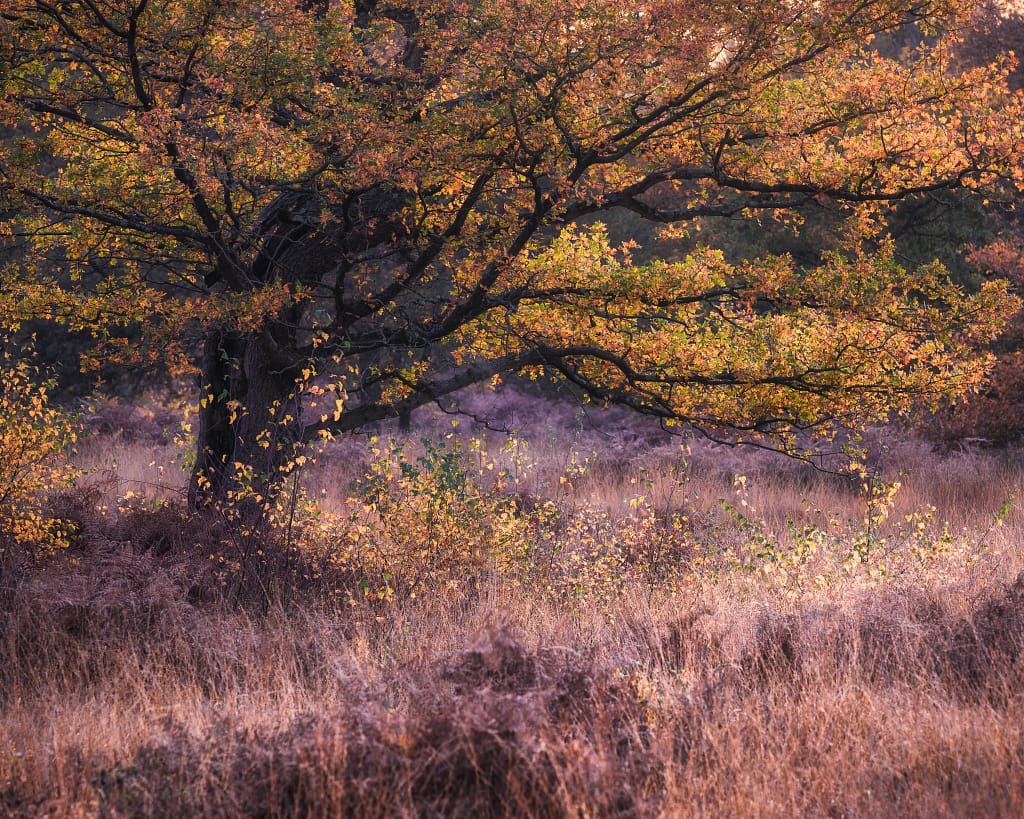
Wider focal lengths, like 24mm or 28mm, bring more tension and exaggerate perspective. That can work well when you’re working with bold leading lines, strong foreground shapes, or dynamic tree arrangements. But it also increases the risk of messy compositions unless everything is carefully placed.
With longer lenses, the energy shifts. You quiet the frame down and give space for rhythm and visual repetition to emerge. A good example is when I spot repeating tree trunks receding through soft mist. At 105mm or 135mm, those patterns become much easier to isolate and highlight.
Understanding how focal length influences the composition is one of the most overlooked aspects of forest photography. If you're finding your images feel a little messy or hard to read, adjusting your focal length may help more than changing your subject. You might also enjoy my breakdown of common woodland photography mistakes, where I discuss how over-reliance on wide angles or zooming without intention can lead to flat, confusing compositions. Choosing a focal length that matches how you see the forest is one of the simplest ways to improve your images. No new gear is needed.
Conclusion: Find Your Focal Length by Slowing Down
There’s no universal best focal length for woodland photography. But when you slow down, take time to observe, and let the forest guide your decision, certain patterns start to appear.
For many photographers, the ideal focal length for forest photography lies somewhere between 35mm and 135mm (For me, most of my photos are between 40-50mm and 75-85mm).
This range offers flexibility. It gives you space to simplify chaotic scenes, isolate shapes, and still include enough of the surrounding environment to feel grounded. It’s where subject clarity and compositional control meet.
The best woodland images often begin before the camera comes out. You frame the scene in your mind. You notice the rhythm between the trees, the direction of light, or the way certain shapes interact. Instead of asking which lens is best, you begin to ask: what focal length reflects how I see this scene?
That’s the real shift. You stop chasing gear and start trusting your instincts.
If you’d like to build more confidence in how you see and compose woodland images, download my free guide, Taming The Chaos: The Key to Better Woodland Photography Compositions. It will help you simplify your process and see your local woods with fresh eyes.
If you're ready for personal guidance, my 1-to-1 woodland photography workshops are designed to help you refine your approach, improve your compositions, and reconnect with the creative part of yourself that brought you to photography in the first place.
Woodland photography isn’t about technical perfection. It’s about making honest images that reflect what you saw and felt. When you learn to choose your focal length deliberately, the forest becomes more than a backdrop. It becomes a conversation.