
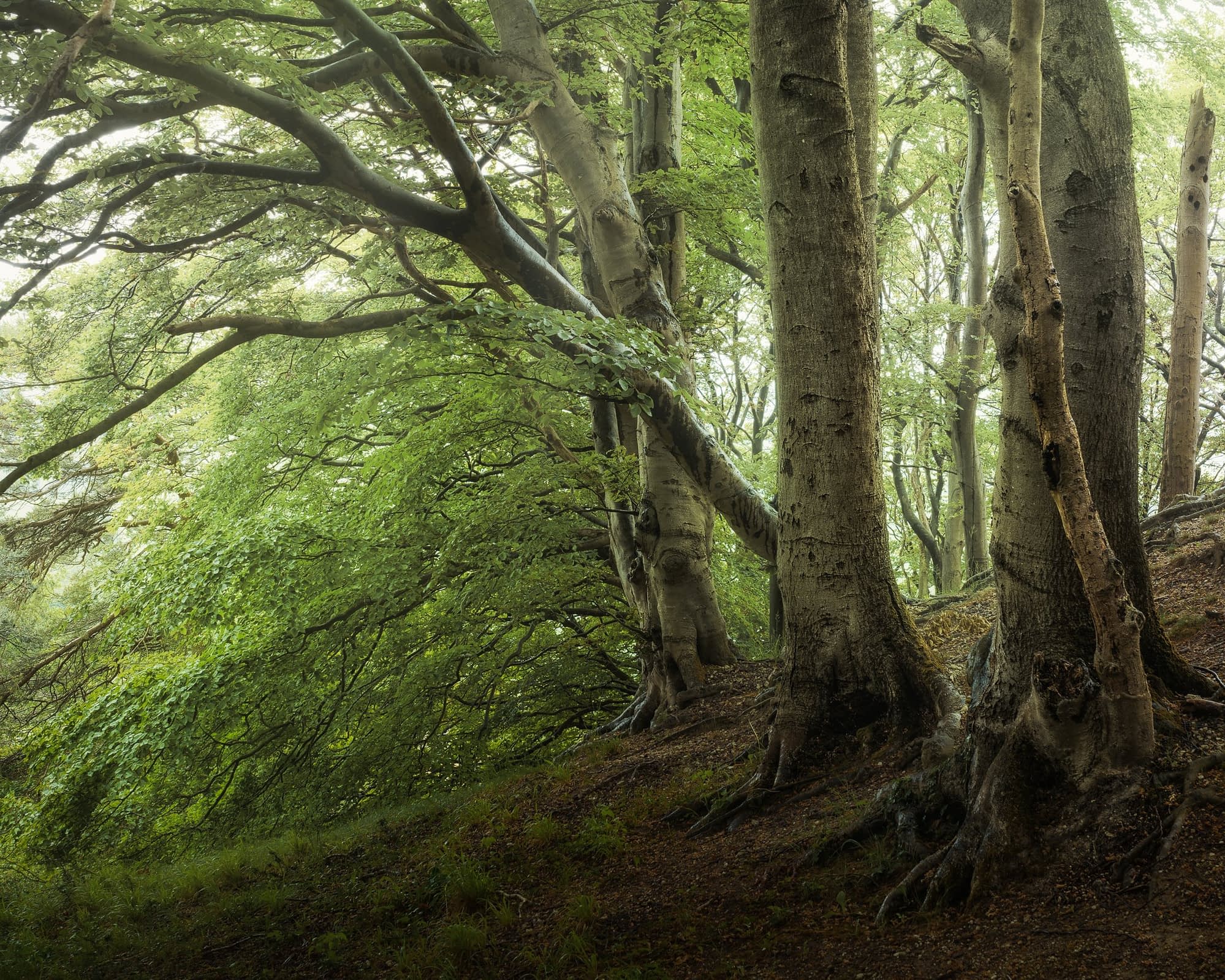
There is no single best focal length for woodland photography, but most of my images are made between 40mm and 85mm, with a smaller number at 110mm to 135mm. The standard range keeps enough of the wood for context while giving just enough compression to clean up the background. Wide angles need mist or strong shapes to work. Long lenses are for something you have already seen from a distance.
Go too wide and everything feels chaotic. Zoom in too far and you lose the character of the place. It is a balance many photographers struggle with, and the honest answer is that the number on the lens matters less than the relationship between the things in front of it.
This guide is shaped by years of walking in local woods, framing scenes with nothing but a composition window and my eyes before I even reach for the camera. I have shot everything from ultra-wide to long telephoto, but over time I have returned to a few ranges that feel natural to me. What follows is what each one actually does in a wood, which I reach for most, and how I decide before the camera comes out of the bag.
In this article
Why focal length matters in woodland photography
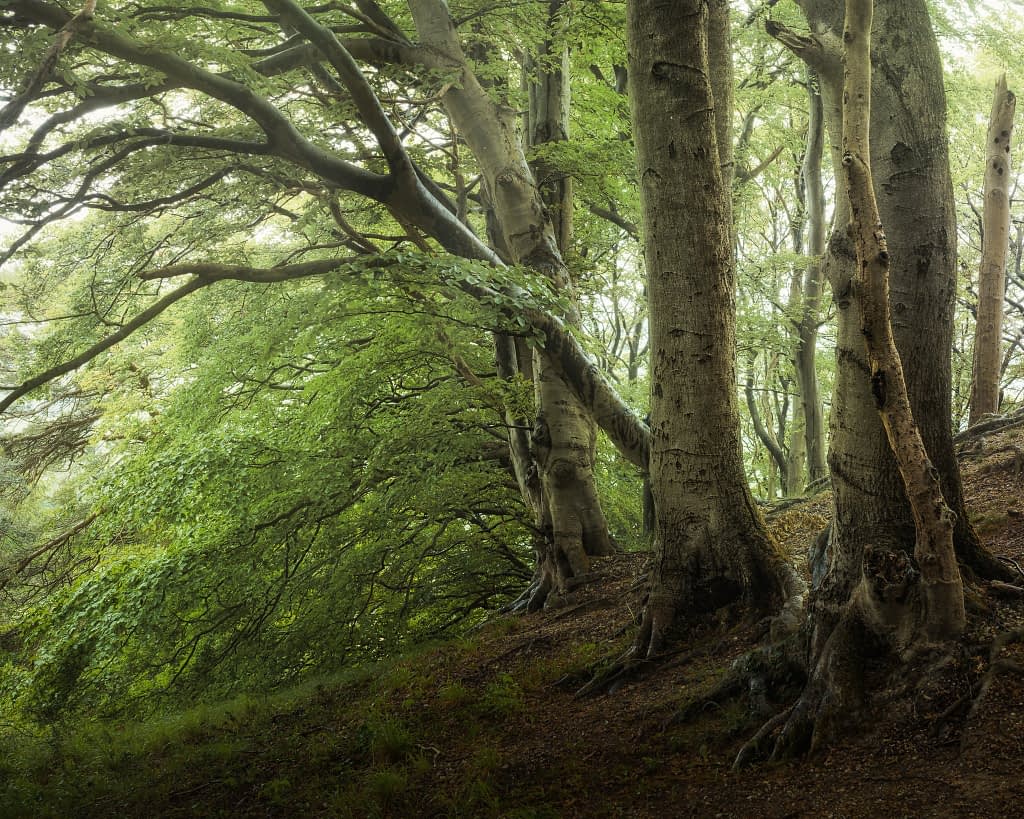
Focal length changes how you experience the frame, not just how close the subject appears. It decides how much of the wood you take in, how depth reads, and how much of the clutter you have to organise before the picture works.
When I started, I defaulted to wide-angle lenses. I loved the immersive feel, and I came home with chaos: branches jutting in from the edges, bright holes in the canopy, compositions that looked better in person than they did in camera. What I did not understand then was how much the focal length was doing to the scene before I had made a single compositional decision.
Wider angles exaggerate depth and pull in more of the surroundings, which works when the wood has strong structure and a clear subject. Most woods do not. They sprawl in every direction and overwhelm the frame. A longer focal length simplifies before you have even started. That is the whole reason it matters here more than in most kinds of landscape work, and it is closely tied to woodland photography composition basics.
What does each focal length do in a wood?
Each range has a job it does well and a job it does badly. Here is how they behave once you are standing among the trees, rather than reading numbers on a box.
Wide angle, 16mm to 35mm: when does it work?
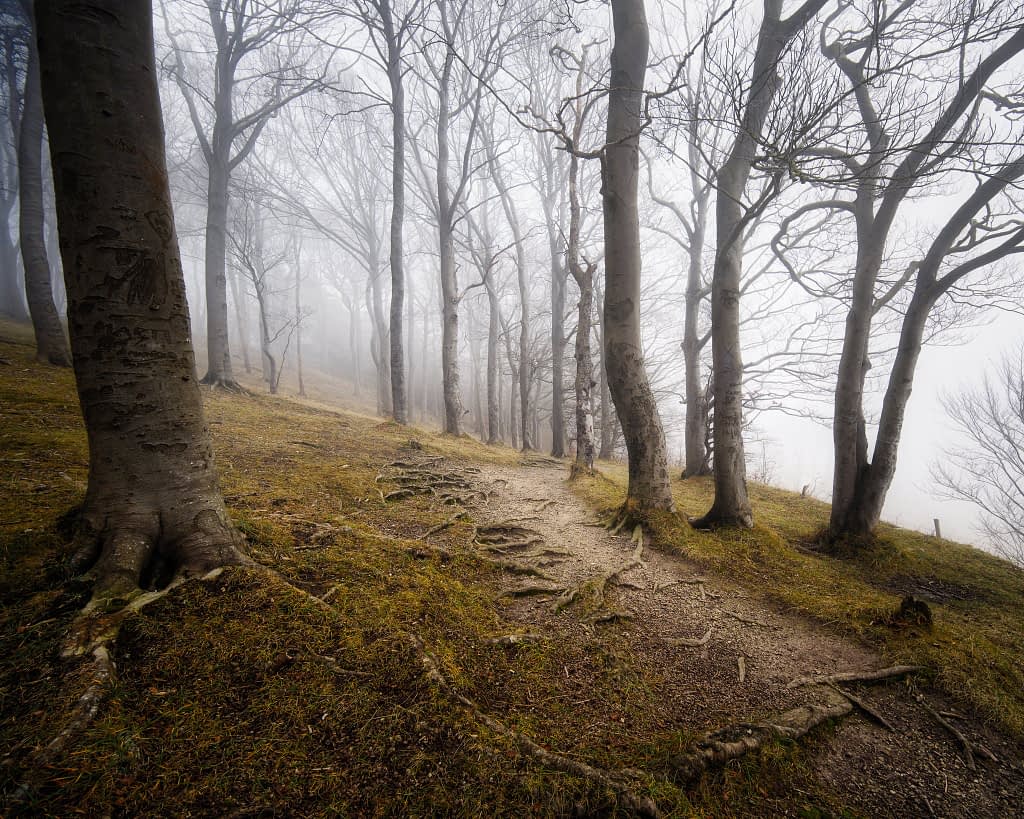
I started wide, because everyone does, and the results taught me its limits. Wide angle works in a wood when the conditions do the simplifying for you. At 16mm in fog, with the roots close and the trunks fading behind them, it works beautifully. On an ordinary bright morning it mostly does not, because the lens includes so much that stray branches and busy backgrounds creep in from every edge.
So I reach for the wider end, around 16mm to 24mm, mainly in fog or heavy mist, where the distance is already hidden and the scene arrives half-simplified. There is more on that in photographing woodland in fog. Without those conditions, or without a genuinely strong shape to anchor the frame, wide angle in the woods is more frustrating than rewarding, and simplifying it takes patient, small shifts of position to keep the edges clean.
Standard, 35mm to 70mm: the range I live in
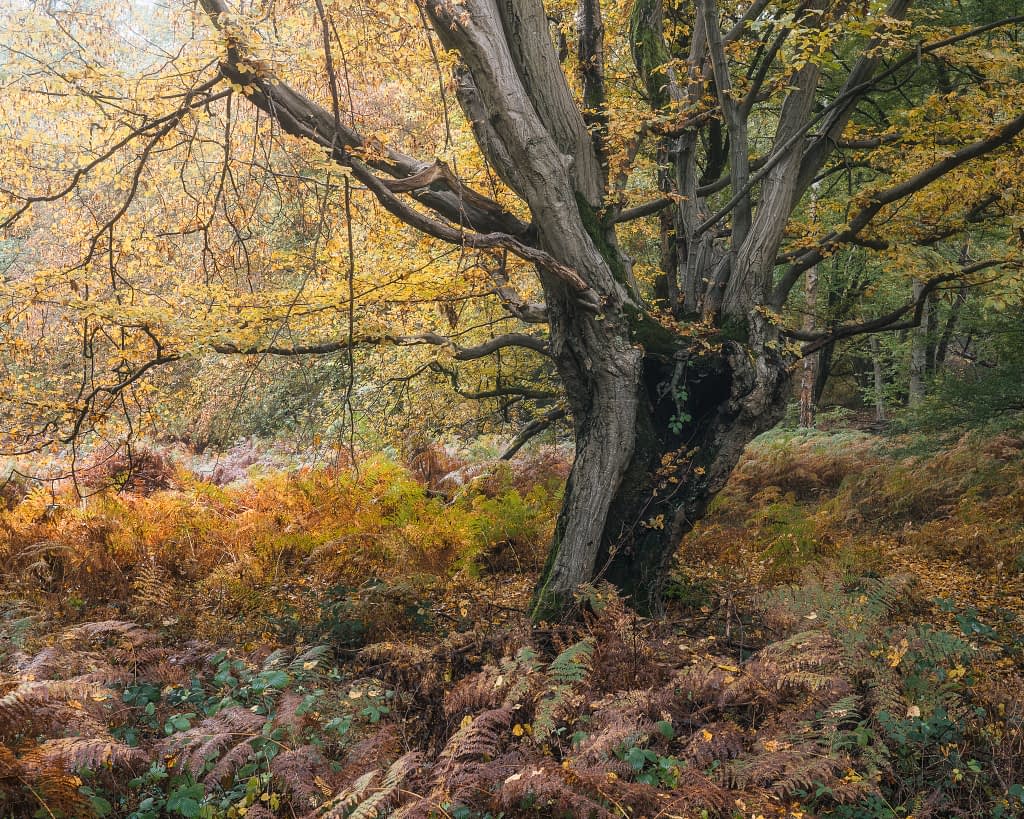
Focal lengths from 35mm to 70mm are where I feel most at home. This range sits close to how we see the wood with our own eyes, and it strikes the balance I am usually after: enough context to show where I am, enough compression to tidy the background. I probably shoot more woodland at 40mm to 50mm than anything else.
It earns its place in soft light, in mist and light rain, where background separation happens on its own. I often find myself composing with just a few trunks interacting or catching the light, and at this range a subtle relationship can be shown without exaggerating or flattening it. The images tend to be quiet ones, about rhythm and flow rather than drama, and they feel true to the experience of being there. When the light itself is the subject, light and shadows in woodland photography goes further into it.
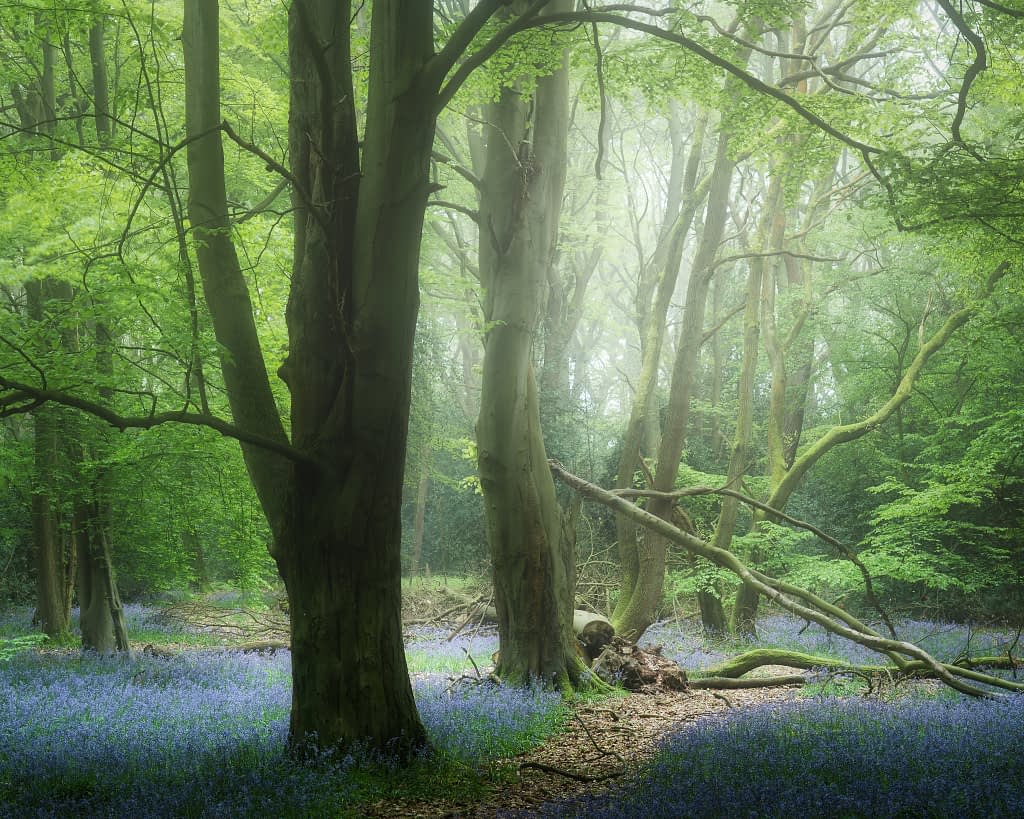
Short telephoto, 70mm to 135mm: isolating without cutting off
Between 70mm and 135mm I can isolate a pair of trunks without cutting them off from the wood around them. Around 85mm to 105mm is where I land most. It gives me enough compression to quieten a background and bring order to the frame without making it look flat, and it lets me work with trees that are a little further off but still part of the same stand.
There is a particular intimacy to it. At 105mm I might notice a gentle bend in a branch, or the way two trunks echo each other at an angle, quiet gestures that a wider lens loses entirely. A zoom that covers this range is useful in the woods, not so you can zoom constantly, but so you can dial in the exact focal length that matches what you saw and then leave it there.
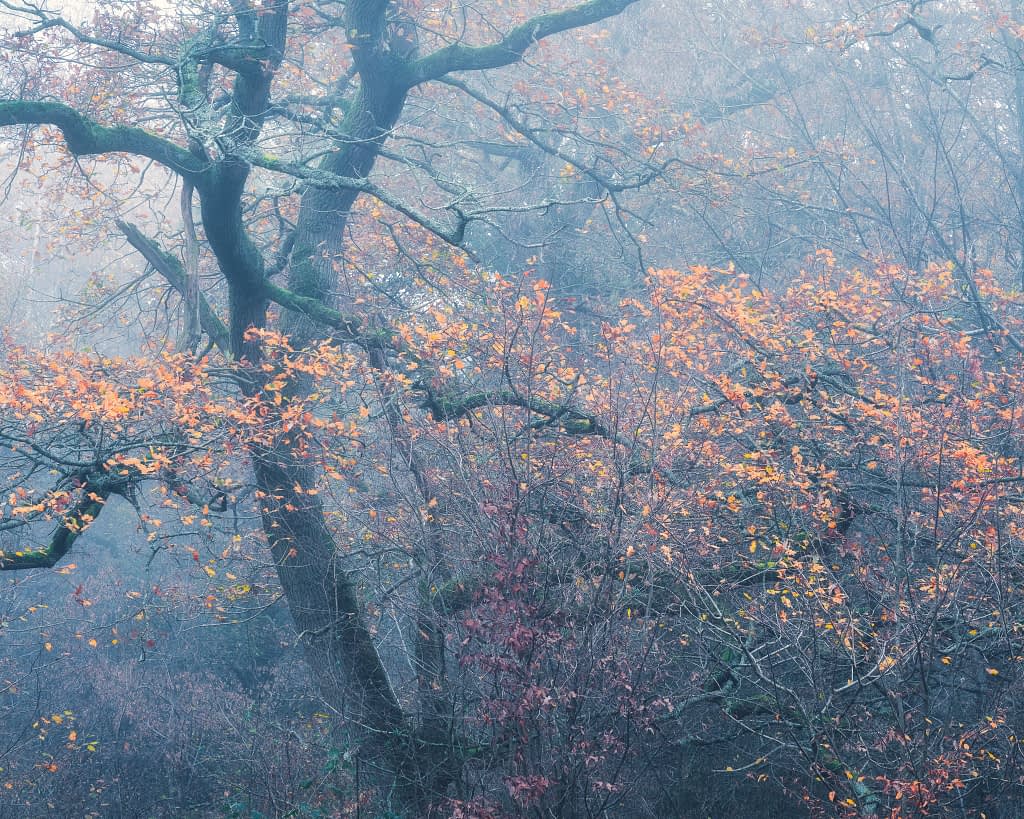
Long telephoto, 135mm and beyond: for something already seen
Long focal lengths, from about 135mm up, are not my everyday choice, but I keep returning to them for moments when compression and distance add something the other ranges cannot. I reach for a telephoto lens when I have spotted something from a distance: a glowing tree catching the first light, or a cluster of trunks that line up when seen from across open ground. At 160mm or 200mm I can isolate that without walking into the scene and disturbing it.
The compression flattens the space just enough to separate the background, which is exactly what a cluttered wood needs. The trade is that these frames are hard-won. The narrow field of view means small changes in position make a large difference, and I have spent whole mornings adjusting by a foot or two just to keep a branch from crossing the frame.
It is slow work, but it is often where the strongest woodland photographs come from. A long lens also invites a different kind of seeing: you are not reacting to what surrounds you, you are scanning for relationships that only appear at distance. Steady work like this is far easier with a tripod that suits the woods.
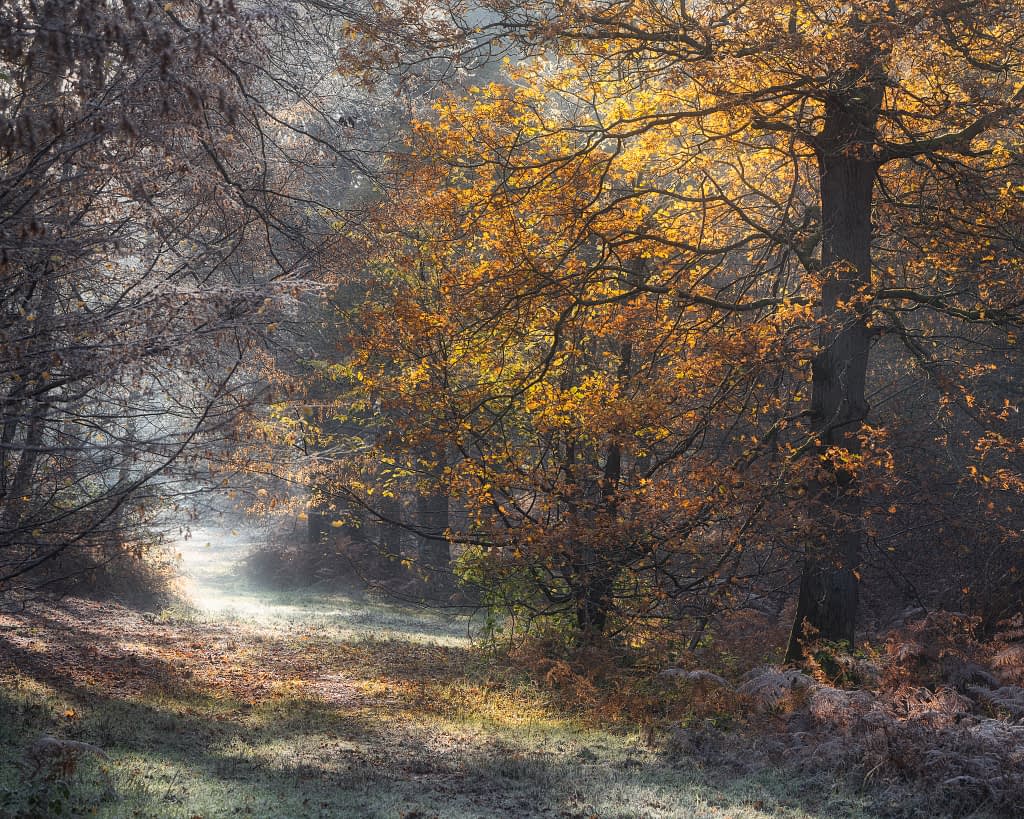
Which focal lengths do I use most?
Some focal lengths simply feel right. I keep coming back to 40mm to 50mm, 75mm to 85mm and 110mm to 135mm, not because of any rule, but because they suit the way I see when I photograph woodland. Before I lift the camera I slow down and look, sometimes framing with a View Catcher or just my fingers, and when something works I note the focal length that would recreate it. More often than not it falls in one of those three ranges.
The 40mm to 50mm range gives a grounded, natural view that holds enough of the scene without letting it turn messy. At 75mm to 85mm I start reducing clutter and opening up separation between elements. By 110mm to 135mm it becomes easier to isolate the rhythm in the trees and carve some order out of a dense background. I use all three the year round, depending on how the wood is built and how I am seeing that day. If you want to see them at work, my British Woodland gallery is composed largely within those ranges.
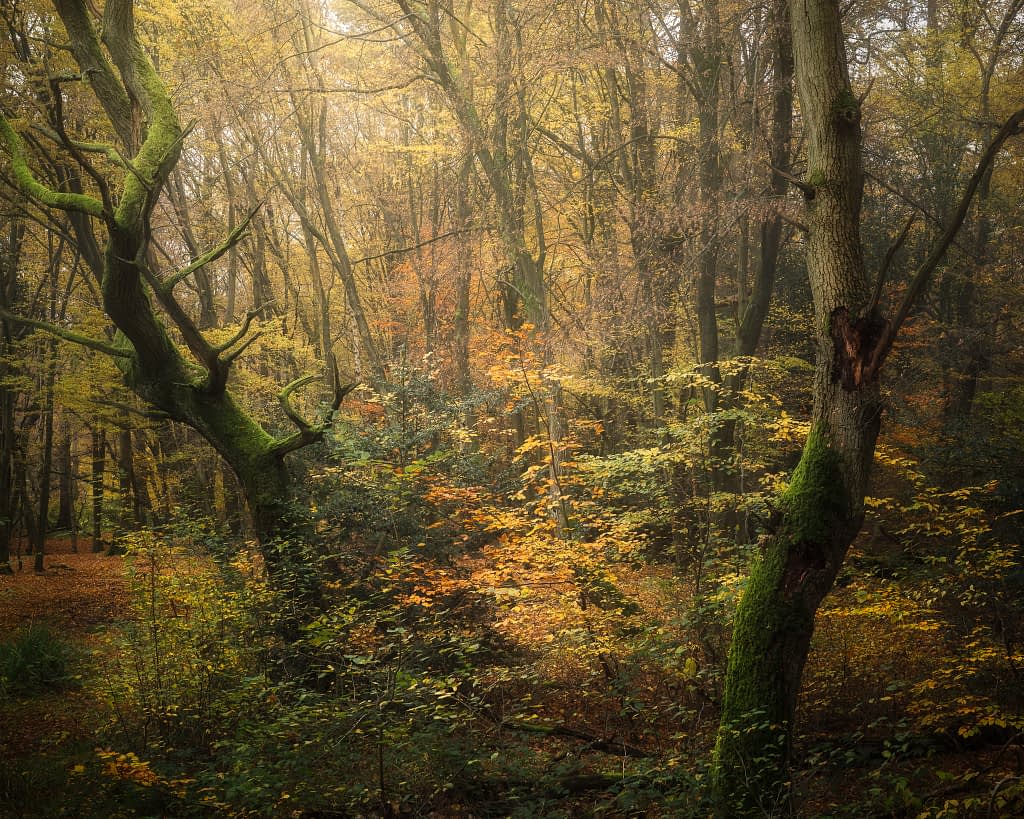
How do I choose a focal length before the camera comes out?
I start with a question: what am I trying to say about this part of the wood? The atmosphere of the place, the quiet rhythm between a few trees, or one specific thing that stopped me. Once that is clear, the focal length follows more easily. I often commit to a single focal length for a whole walk, not as a limitation but because it keeps me seeing consistently, the way I saw the scene in the first place. I use a View Catcher or a simple framing window to explore compositions with my eyes first, note where I stood and which focal length matched what I saw, and only then unpack the gear.
That is also why I use zoom lenses rather than primes: not to cover every focal length, but so I can set the precise one that matches what I already saw, then treat the zoom as if it were a prime and resist changing it.
For what it is worth, here is the kit behind these images. Most of my woodland work is made on a Sony FE 24-105mm F4 G on a Sony A7R V, because it covers the range I live in and lets me hold one focal length deliberately. When I want to reach into the wood for something spotted from a distance, I switch to the Sony FE 100-400mm F4.5-5.6 GM, and the widest frames, like the roots in fog above, come from a Sony FE 12-24mm F4 G. When it is wet, in rain or fog, I carry the Tamron 28-200mm F2.8-5.6 instead, one lens across the range so I am not swapping glass with wet hands.
None of that is a recommendation to buy a particular lens. The point is that one lens covering your working range lets you choose a focal length on purpose rather than drift through a zoom.
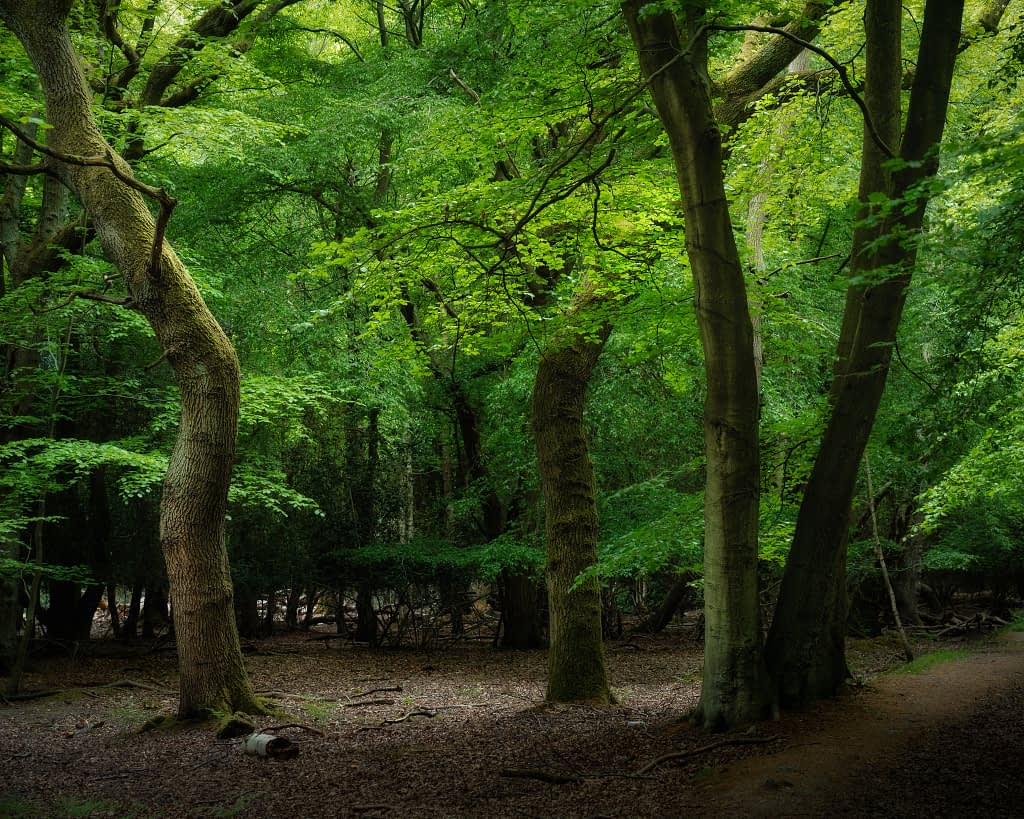
Working this way keeps the process about seeing rather than fiddling. When I use a consistent focal length, the pictures feel more intentional and more cohesive, because I am responding to the structure of the wood instead of second-guessing myself through the zoom range. If you want to plan around the light as well as the lens, the best time for woodland photography covers the seasons and the hours.
How focal length changes the composition
Focal length is not just about magnification. It is one of the most direct tools you have for shaping the mood and structure of a woodland image. When a scene feels too chaotic, changing focal length often does more than moving your subject would.
Longer focal lengths help you isolate tree shapes, draw out patterns, and separate a subject from its background without leaning entirely on shallow depth of field. Even 70mm or 85mm compresses the space enough to clean up a distracting background. This connects closely to where to focus in woodland photography, because the two decisions shape each other.
Wider focal lengths, by contrast, bring tension and exaggerate perspective, which rewards bold leading lines and strong foreground shapes but punishes a scene that is not carefully arranged. If your images feel messy or hard to read, adjusting the focal length will often help more than changing what you point at. It is the quickest way to leave the clutter out. That is the same problem how to simplify busy woodland scenes works through in more detail.
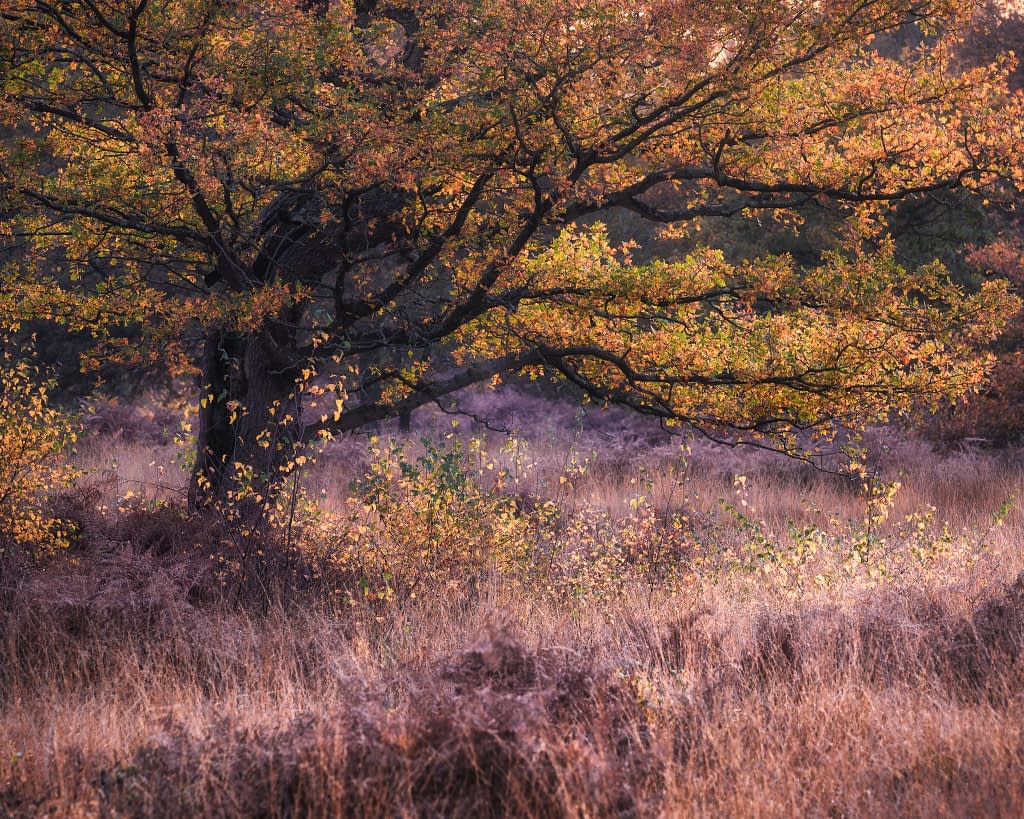
Which lens is best for woodland photography?
If you have read this far hoping for a single answer, here it is: the best lens for woodland photography is the one that comfortably covers 35mm to 135mm, used with intention. A standard zoom in that range will make the large majority of the images most people want from a wood, and it will do it without asking you to carry much. A longer lens earns its place once you start seeing relationships at distance, and a wide one earns its place mainly in fog. But if you own only one lens for the woods, a mid-range zoom is the one to have.
What matters more than the lens is how you use it. A prime forces one focal length on you, which can be a good discipline, but a zoom used as a prime gives you the same discipline with more reach: choose your focal length deliberately, then hold it. The lens is not the thing that makes the picture. The relationship you saw is.
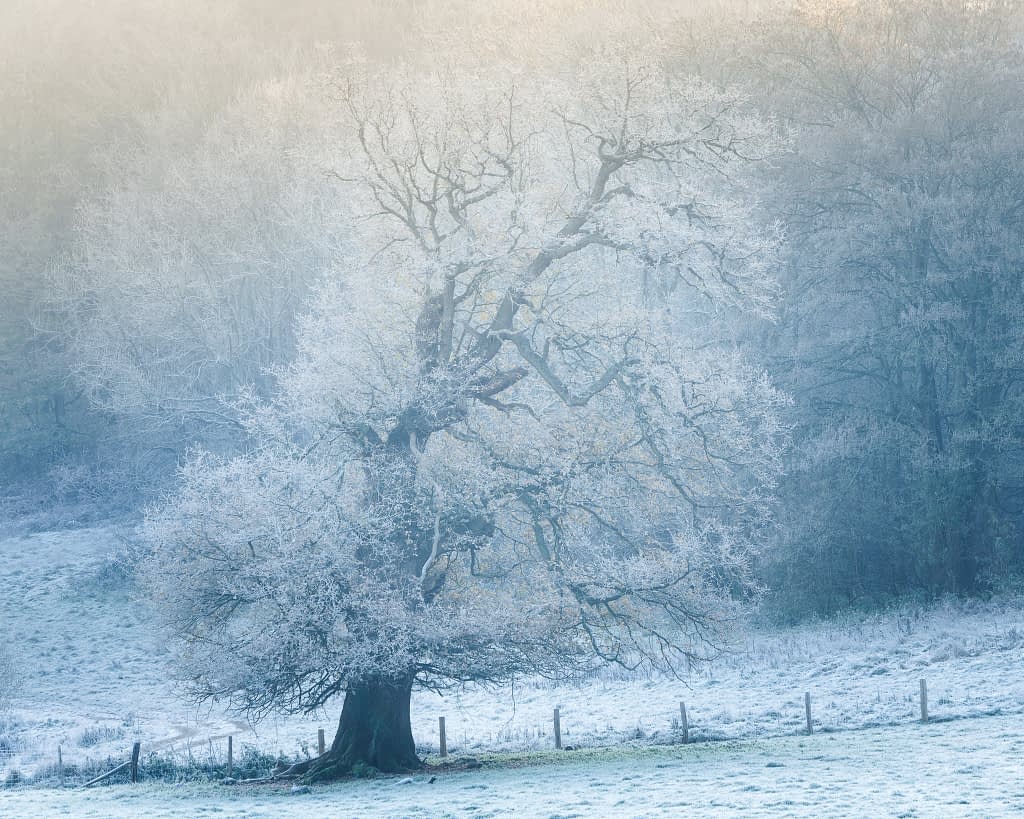
Conclusion: find your focal length by slowing down
There is no universal best focal length for woodland photography. But when you slow down, watch, and let the wood guide the decision, patterns appear. For most photographers the useful ground lies between 35mm and 135mm, and for me most images fall between 40mm to 50mm and 75mm to 85mm. That range gives you room to simplify a chaotic scene, isolate shapes, and still hold enough of the surroundings to feel grounded.
The best woodland images often begin before the camera comes out. You frame the scene in your mind, notice the rhythm between the trees and the direction of the light, and only then ask which focal length reflects how you see it. That habit of seeing first is the whole of it, and I have written more about cultivating it in farming compositions. Stop chasing gear, and start trusting what you notice.
If you would like to build more confidence in how you see and compose woodland images, download my free guide, Taming the Chaos: The Key to Better Woodland Photography Compositions. It will help you simplify your process and see your local woods more clearly. And if you would rather work it through in the field, I run 1-to-1 woodland photography workshops.
Woodland photography is not about technical perfection. It is about making honest images that reflect what you saw and felt. When you choose your focal length deliberately, the wood becomes more than a backdrop. It becomes a conversation.
Frequently asked questions
What focal length do you use most in the woods?
Most of my woodland images sit between 40mm and 85mm, with a smaller number at 110mm to 135mm. The 40mm to 50mm range gives a natural, grounded view, and the short telephoto end lets me separate a subject from a busy background. I choose within those ranges by what the scene needs, not by habit.
Is a wide-angle lens good for woodland photography?
It can be, but it is the hardest range to use well. Wide angle works when the conditions simplify the scene for you, such as fog or heavy mist, or when there is a genuinely strong shape to anchor the frame. On an ordinary bright day it tends to pull in stray branches and busy backgrounds, so I use it sparingly.
Do I need a telephoto lens for woodland photography?
Not to start with. A standard zoom covering 35mm to 135mm will make most of the images you want. A telephoto earns its place once you begin noticing relationships between trees at a distance, and want to isolate them without walking into the scene. It is a second lens, not a first one.
Is a zoom or a prime better for woodland photography?
There is no single best lens for woodland photography, but I prefer a zoom used as if it were a prime. I set the focal length that matches what I saw, then hold it and resist changing it. A prime gives you that discipline by force; a zoom gives you the same discipline with more reach, which suits the way a wood asks you to work.
Does a longer lens simplify a busy woodland scene?
Often, yes. A longer focal length narrows the field of view and compresses the space, which leaves out clutter at the edges and separates your subject from the background. It is usually a faster fix for a messy frame than changing your subject or your position, though small shifts of position still matter at longer focal lengths.
