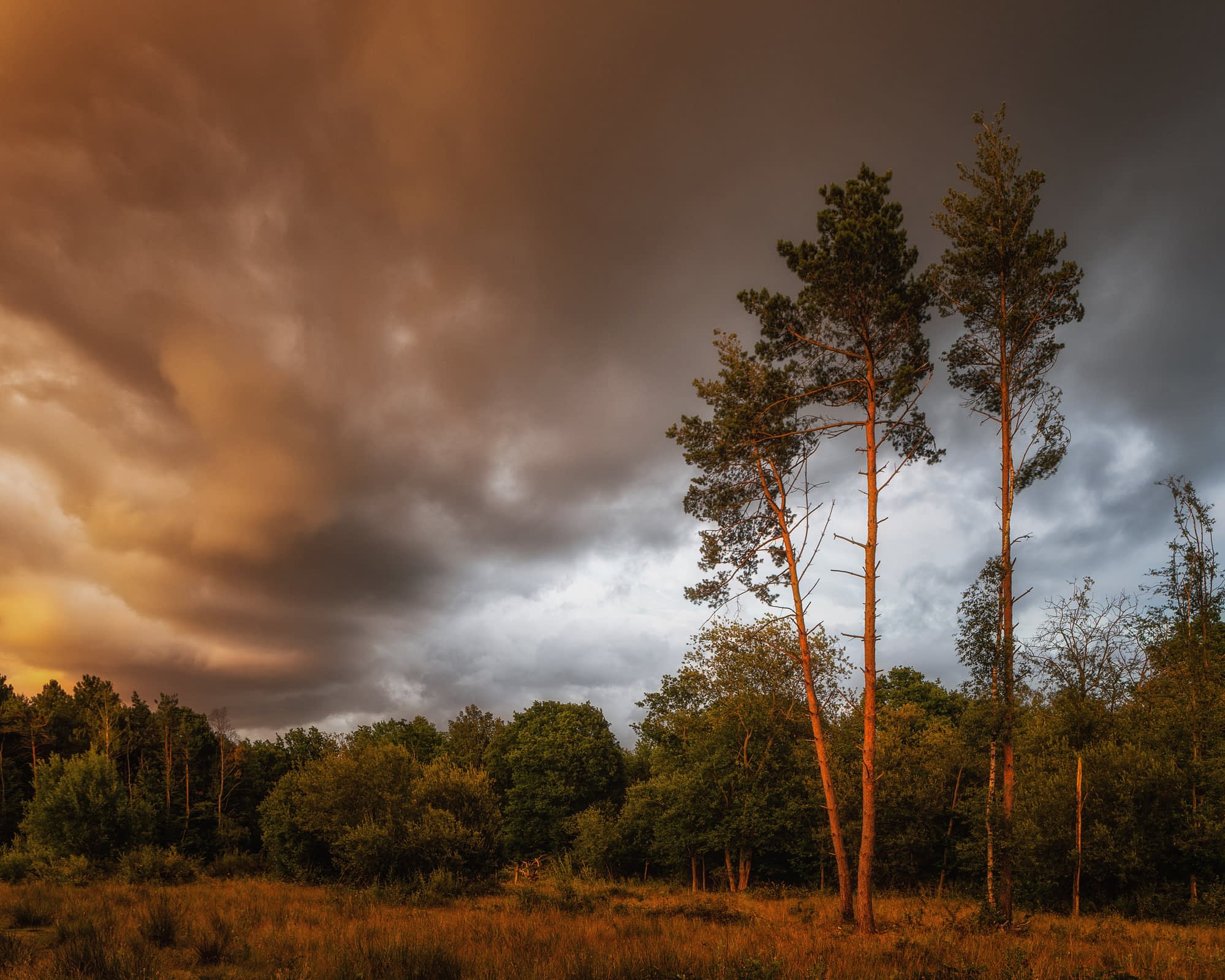
There is a photograph I made sometime in the mid-late 2000s that won an award. I cannot remember which award or which competition, but I remember the image clearly: a wide coastal view, a dramatic sky doing exactly what dramatic skies are supposed to do, the kind of light you drive three hours for and sometimes, just sometimes, receive. I composed it well. The exposure was correct. The judges agreed. But I felt nothing.
That feeling has stuck with me ever since.
Before the woods, I was a collector of views. I thought that was landscape photography.
But looking back, what I was really doing was hunting. Hunting for the light, hunting for the conditions, hunting for that convergence of effort and fortune that produces the image you had already imagined before you left the house.
The journey was always in service of the pre-visualised result.
The misreading of Ansel Adams' concept of pre-visualisation is at the root of it.
We have inherited a version of pre-visualisation that essentially means: imagine the finished image in perfect conditions, then go and wait until the world delivers it. This reading turns photography into a kind of fulfilment operation: desire, logistics, execution. It makes the photograph a trophy for patience and planning rather than an act of genuine seeing.
But consider how Adams described Moonrise, Hernandez, New Mexico. It is perhaps the most studied image in the history of American photography. He made it in forty seconds, in failing light, working almost entirely from instinct and technical reflex. There was no pre-imagined scene. There was no waiting for the world to match his vision. What he pre-visualised, if anything, was the print: the tonal relationships, the emotional register, the darkness of the sky and the luminosity of the crosses in the graveyard. The scene arrived and he responded to it.
It is about knowing yourself well enough to respond when the world offers something genuine.
I did not understand this. I kept driving.
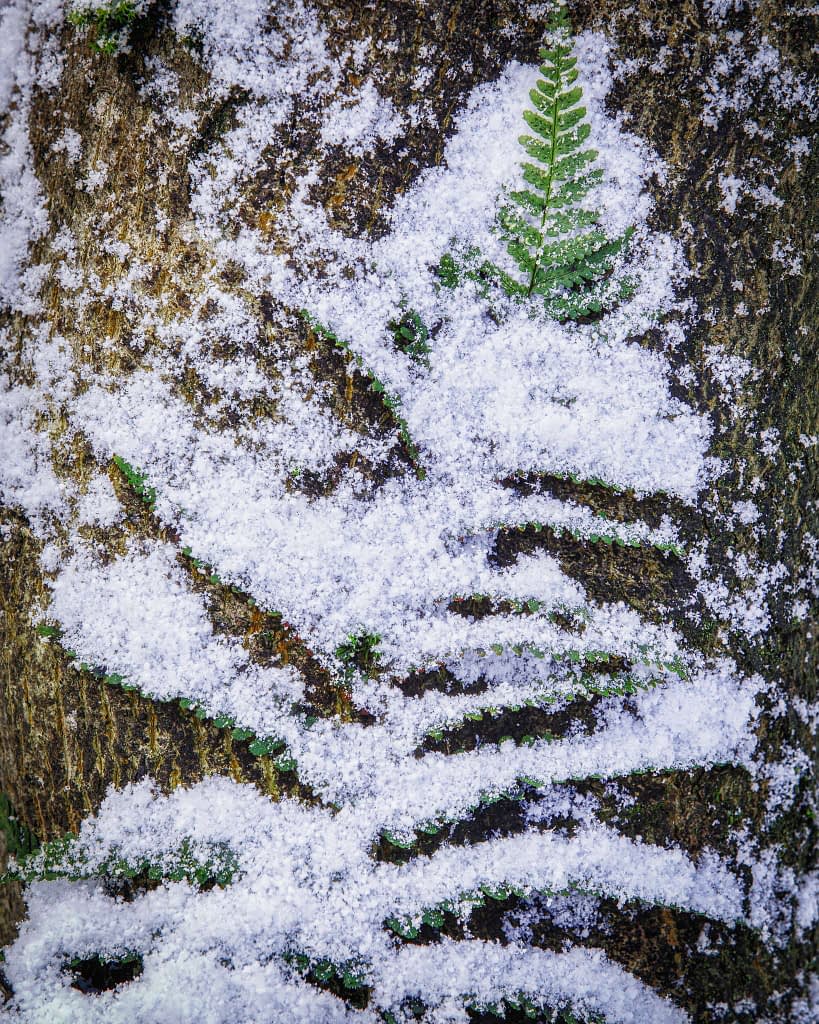
For a long time, one of my most visited locations sat on top of a hill. To reach it I walked through woodland, head down, focused on the destination. One cold morning, snow had arrived without warning. The ferns were still green. Something caught the corner of my eye: the tip of a fern, half-buried in snow, clinging to the bark of a blasted trunk. I almost walked past it. But I stopped. I raised my camera. It was the first time in a long time that curiosity had stopped me rather than a plan.
I started to recognise that the only sustainable model, for me at least, was depth rather than breadth. This is not really about geography. A photographer who chooses a distant landscape and returns to it obsessively through the seasons over many years, until they know it as intimately as their own garden, is doing the same thing I am describing. The commitment is to depth. Not proximity. Faithfulness.
For me, the faithfulness happens to be local. I work in Hertfordshire, a county people tend to drive through on their way to somewhere more dramatic further north. I have read photographers describe it as boring, as a place where serious landscape photography simply cannot happen. I understand the logic, even as I reject the conclusion.
It is the logic of the collector: if a place is not already on the approved list, it does not count. What that view misses, what fifteen years of looking has shown me, is that the beauty is there. It is simply not the kind that announces itself. You have to go looking, and then keep looking, long after most people would have moved on.
Most of my photography takes place within ten or twenty minutes of my front door, and almost none of it requires more than an hour's travel. When the light changes, when the mist sits unexpectedly in the woods, when the frost arrives overnight, I can simply go. There is no three-hour drive to justify.
Adams believed that twelve significant images in a year was a good year. Not twelve popular images. Twelve that meant something. I share far more than twelve images a week, but the ones that stay with me, the ones that feel genuinely mine, are rarer than that. They rarely come from the places I planned to be.
Photography is a huge part of my life. I see images even when I don't have a camera. But it is not my life. There are things that matter more. Staying close to home means I never have to choose between them. I can go out for forty minutes on a Wednesday morning, make one image I believe in, and be back before anyone notices I was gone.
That is enough. More than enough.
My early woodland and landscape work was still dependent on the hierarchy of light: golden hour, low winter sun, spectacular evening colour. The photographs were competent. Some were beautiful. But I was still, in a sense, chasing conditions. Still waiting for the world to be extraordinary before I believed I could make something extraordinary from it.
It was the trees that freed me from this.
I am not sure I can explain precisely when or how it happened. But somewhere in the woods, in the ordinary grey light of an ordinary morning, I made a photograph that felt true. Not technically correct, not award-worthy, not engineered for maximum impact. True. It had something to say, and what it said felt like mine.
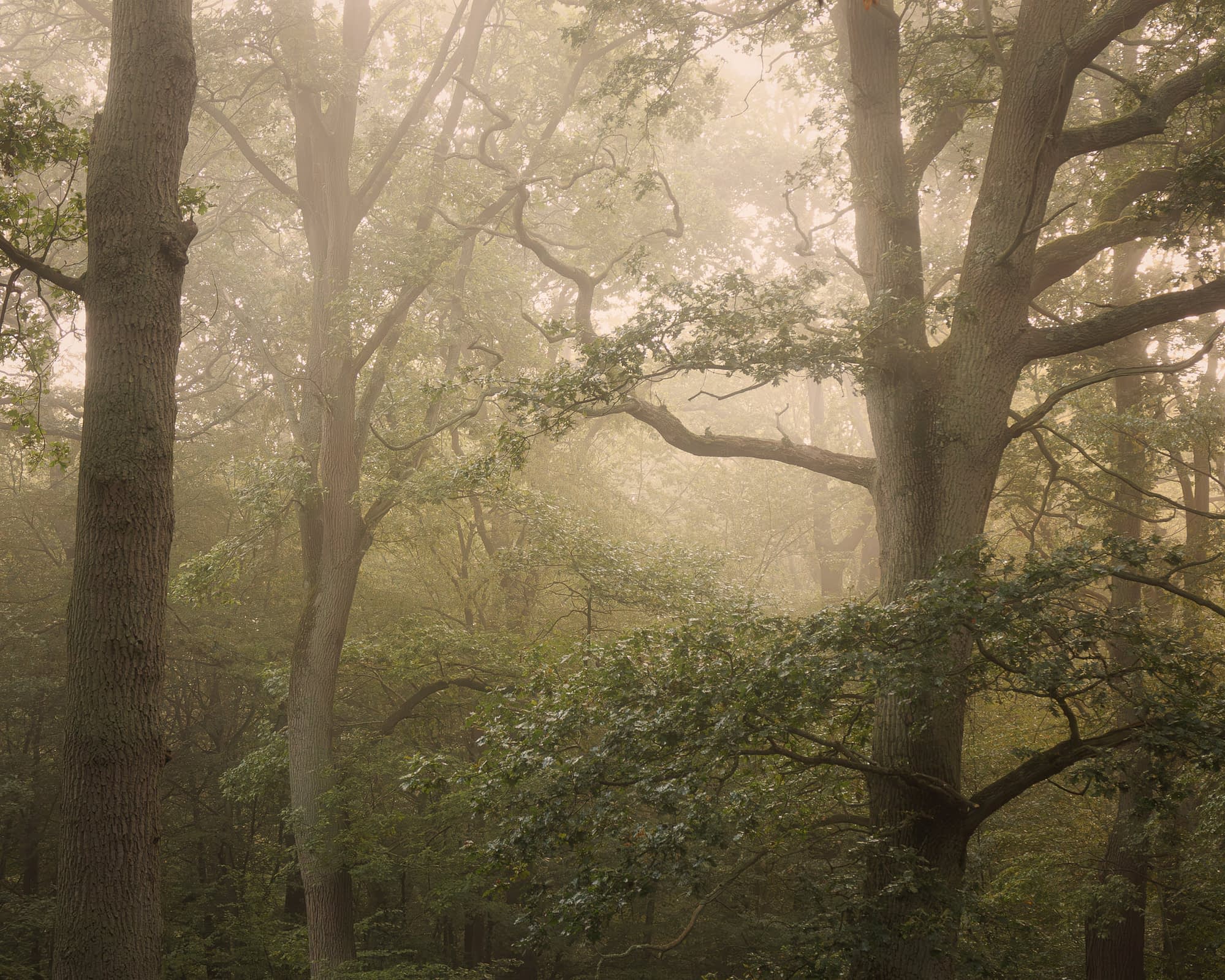
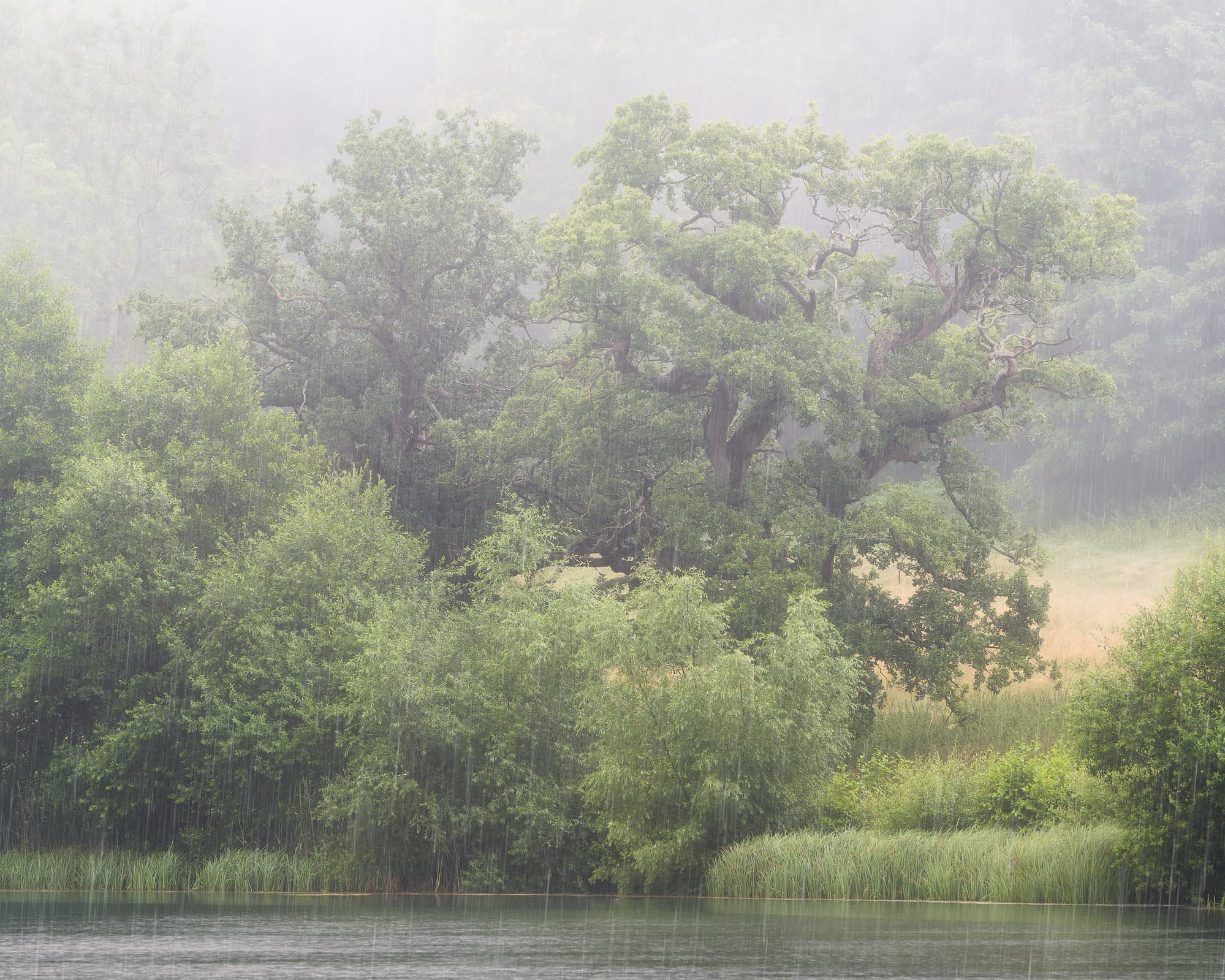
The light was almost theatrical. I was in the woods in heavy rain, and the place felt alive in a way that no golden hour had ever quite matched. A woodland in the rain is not a compromise. It is an invitation.
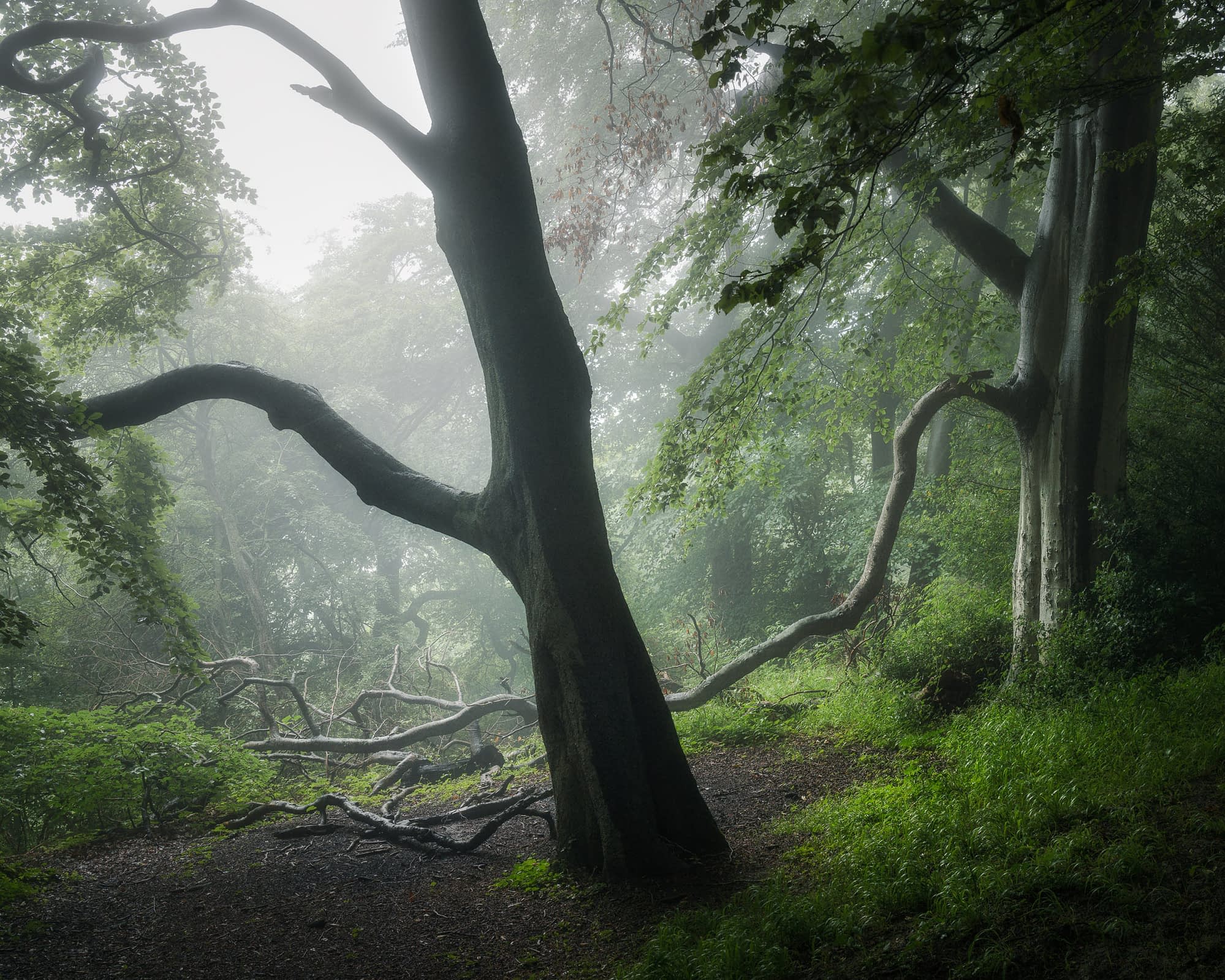
There is a particular woodland I explored for eleven years before I felt I had said everything I needed to say about it. I rarely visit now, except during bluebell season. Eleven years is a long time to spend with one piece of land. Long enough to know it in every season and every weather. Long enough to have walked past the same subjects hundreds of times and understood that what changes between visits is not the subject, but you.
This is what the woods taught me most: that the landscape is partly a mirror. My mood, my temperament, the particular quality of my attention on a given morning, all of these enter the frame whether I intend them to or not. The photograph is never purely of the place. It is also of the person standing in the place, in that moment, in that state of mind.
The woods gave me something else, too. A permission to be curious without a plan. To stop when something caught my eye rather than when something matched my pre-imagined shot. A childlike attention that I had been slowly training out of myself in the years I spent hunting the approved viewpoints. In the woods, I did not need to justify why I had stopped. Nothing needed justifying. I was there, and the light was what it was, and that was enough.
A world requires return. It requires the willingness to be changed by a place, not merely to use it.
I am now a photography teacher as well as a photographer. I run workshops in woodland settings, working with people who are trying to find their own way through the same struggle: the photograph that will perform well, or the photograph that is genuinely theirs. I want to help them hear what the landscape is trying to tell them, in the same way that the woods eventually taught me to listen.
But I also exist in the same algorithmic environment that shapes the photographers I work with. When I share my more expressive, interior work, the images that represent where I actually am creatively, I am not sure the platform is designed to receive them. Social media rewards the scroll-stopping image, the immediately legible impact. It is not naturally hospitable to work that asks for patience, for quiet, for a certain quality of sustained attention.
Even in the woods, the question is there at the moment of making: am I making this image for myself, or for the audience I am building? Am I creating something that speaks for where I am now, or something that meets the photographers I hope to teach where they are? I do not have a clean answer, and I suspect there isn't one.
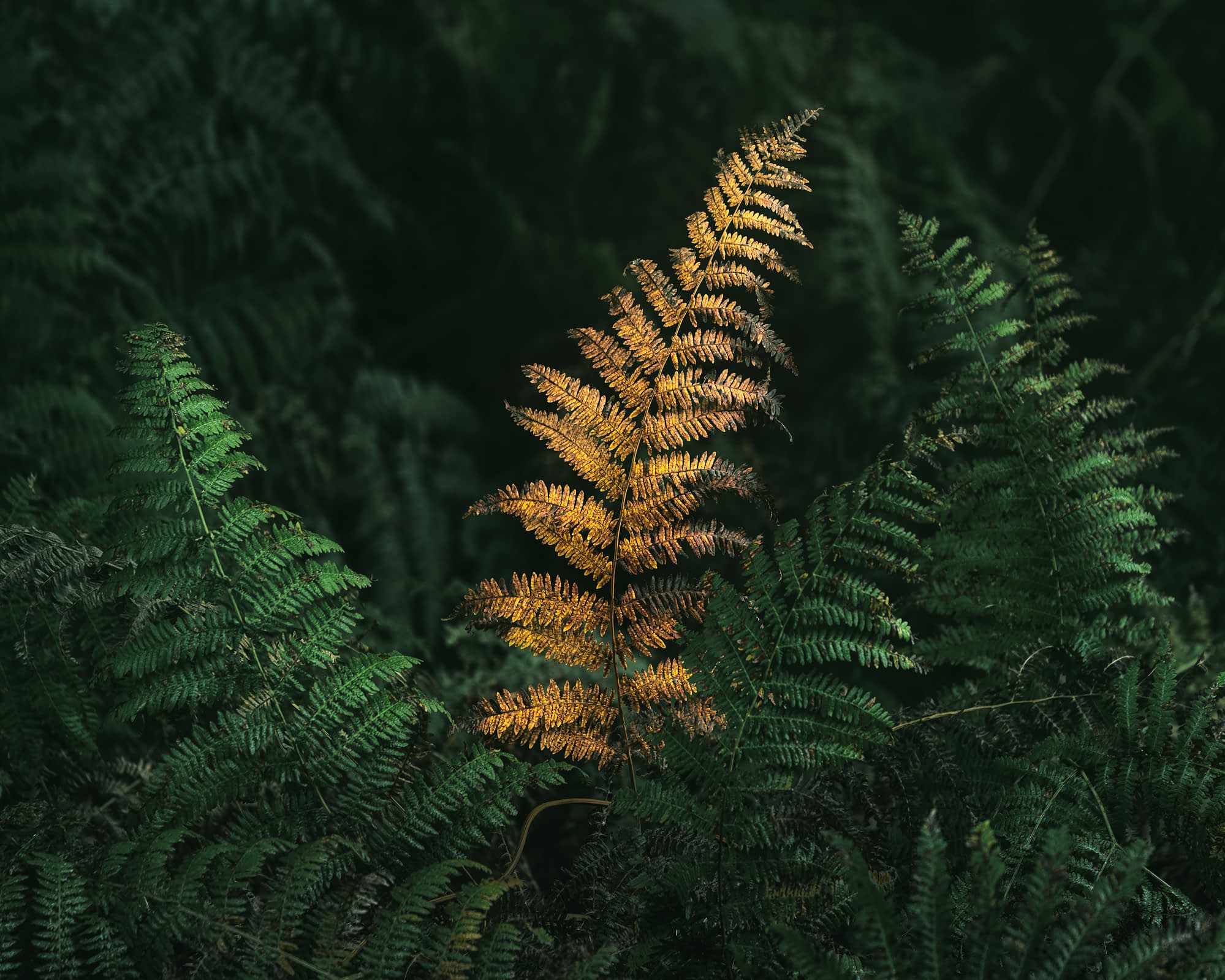
The woods did not give me certainty. They gave me a practice. After fifteen years I am still learning, still curious, still surprised by what a familiar path offers when I arrive with fresh eyes. I learn something new on every visit.
The journey matters. I would not be who I am photographically without the years I spent chasing the wrong things. Those drives, those disappointments, those empty award-winning images, they were the education I needed before I could begin the real one.
Go for a walk. Stay curious. The photographs will come.
But first, ask yourself honestly: the last time you drove three hours for the light, was that for you, or for the approval of people you have never met?