Woodland photography location guide · Essex
Hainault Forest.
A surviving fragment of the old Forest of Essex, holding one of the greatest concentrations of ancient hornbeam pollards in Europe.
Updated on 6 July 2026
Hainault Forest at a glance.
County Essex, on the Greater London boundary near Chigwell
Best for Ancient hornbeam pollards, veteran oaks, trunk detail, fungi
Access Open access on foot. Car park gates open at 8am; street parking nearby for earlier starts
Nearest Station Hainault and Grange Hill, Central Line (Underground)
Size and type Around 280 acres of ancient woodland and wood pasture on the Woodland Trust side, adjoining Hainault Forest Country Park
Peak season Late October to mid November for the hornbeam colour
Parking Chigwell Row car park, IG7 6EZ. Manor Road car park, opposite the Miller and Carter steakhouse, RM4 1NH (both free)
SEVEN YEARS OF VISITS
The wood itself.
The most valuable visit I have made to Hainault Forest was not a photographic one. A few years ago I walked most of the dense woodland with the Woodland Trust site manager, who spent the morning pointing out the ancient trees and the ecologically significant areas the Trust's work centres on. I have been photographing Hainault for about seven years, a visit or so each quarter, and that walk changed how I read the place.
What it confirmed is that Hainault rewards the photographer who goes deeper. There are areas here that feel genuinely remote, and it is hard to believe you are standing on the boundary of London and Essex. Ancient trees stand throughout the wood, and some of the most interesting ones photographically are in the parts that take real effort to reach. That said, some fine ancient trees sit on the shorter circular routes too, so a first visit does not need to be an expedition.
Hainault is a fragment. It was once part of the Forest of Essex, a royal hunting ground, and for centuries local people pollarded its hornbeams for firewood, cutting and recutting the trees until they grew into the knotted forms you find today. Then, in 1851, an Act of Parliament allowed the forest to be grubbed out for farmland. Around 100,000 trees were felled in a few short years and more than nine tenths of the forest was destroyed. The outrage that followed helped save neighbouring Epping Forest and is often pointed to as the beginning of the conservation movement in Britain.
The wood that survives holds what is said to be one of the greatest concentrations of ancient hornbeam pollards in Europe. That is why I keep going back.
From this wood
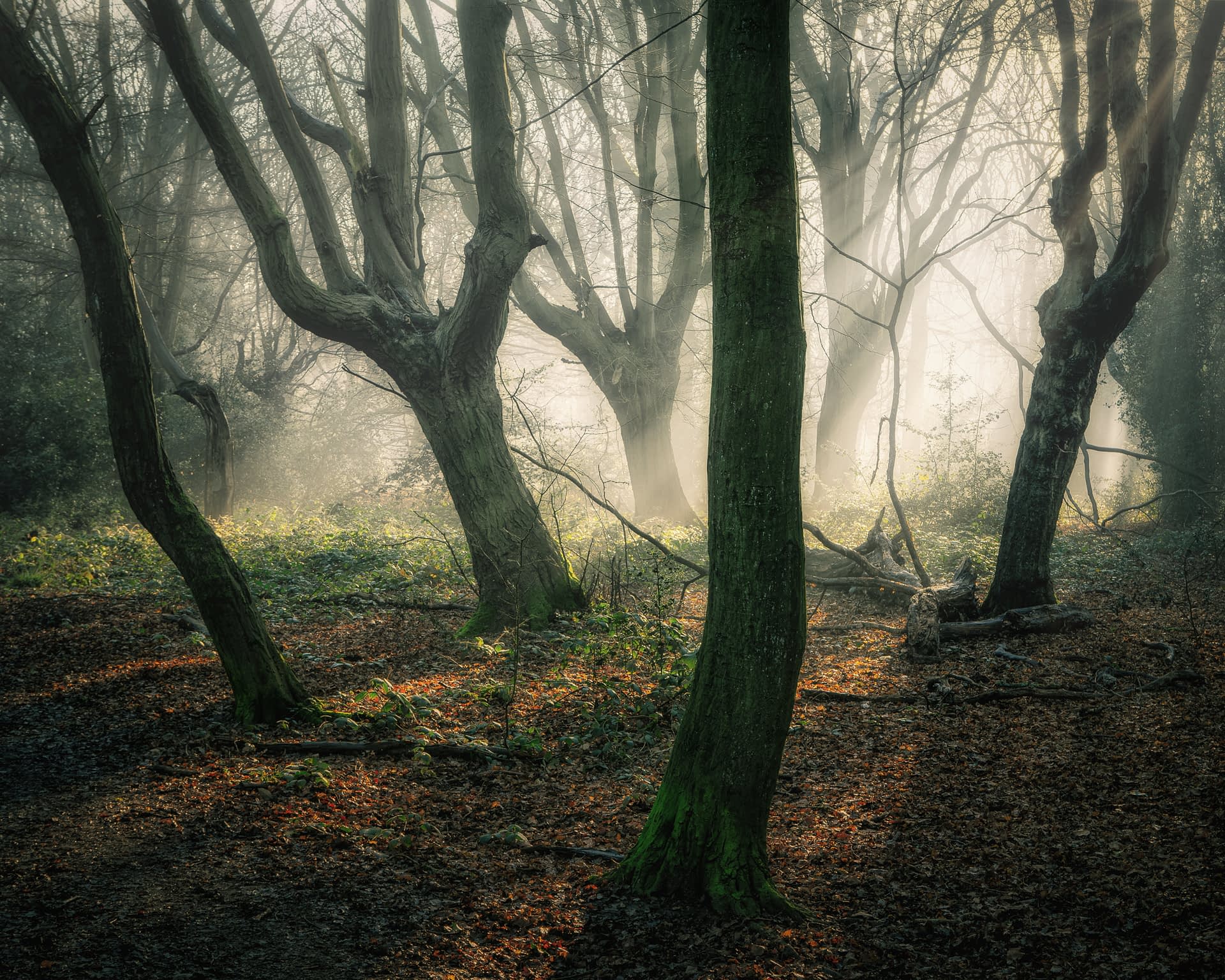
Fog burning off through the pollards. It moves fast here, so when the rays arrive, work quickly.
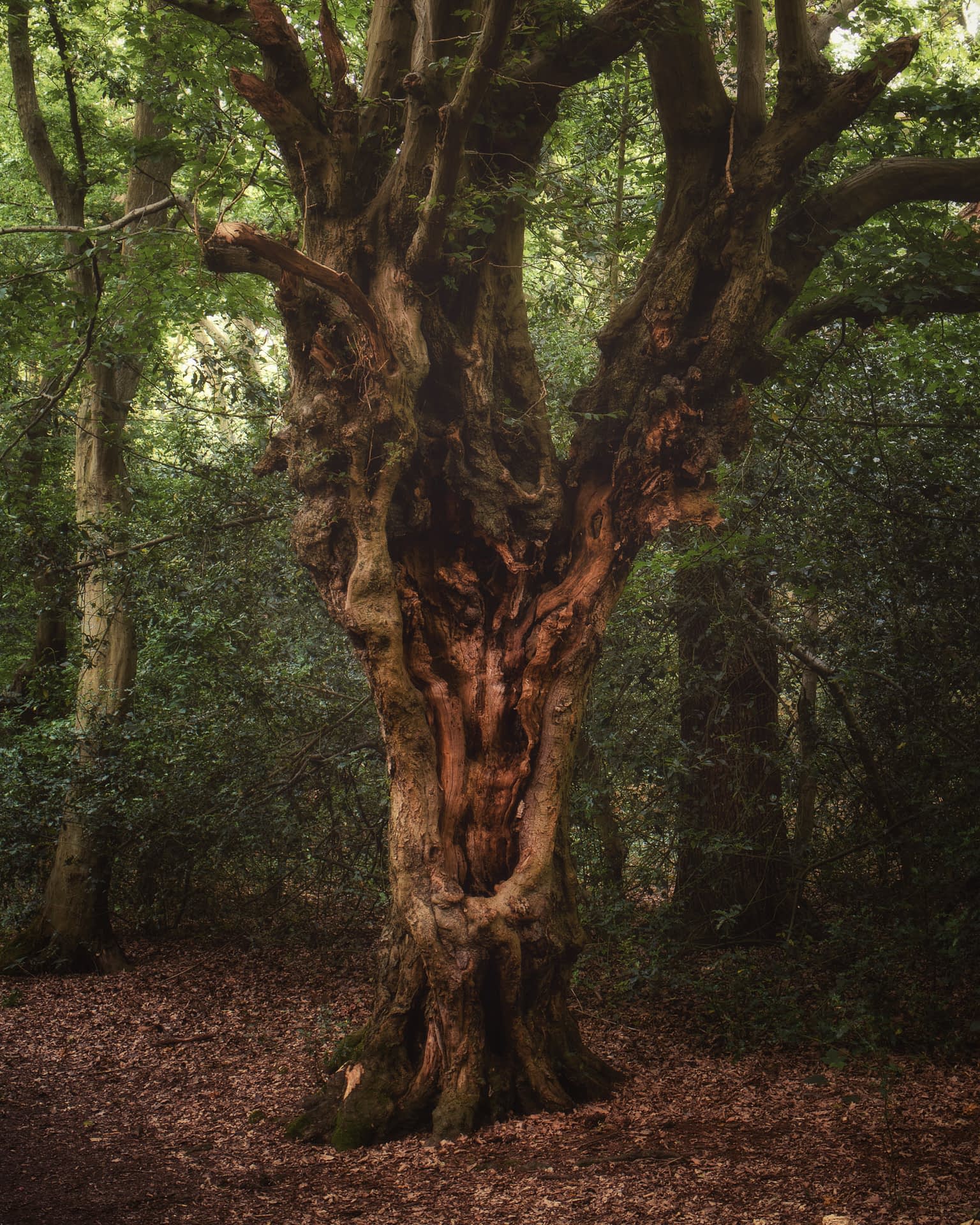
Ancient trees wear their damage openly. The torn heartwood is habitat now, one reason the dead wood here is left where it falls.
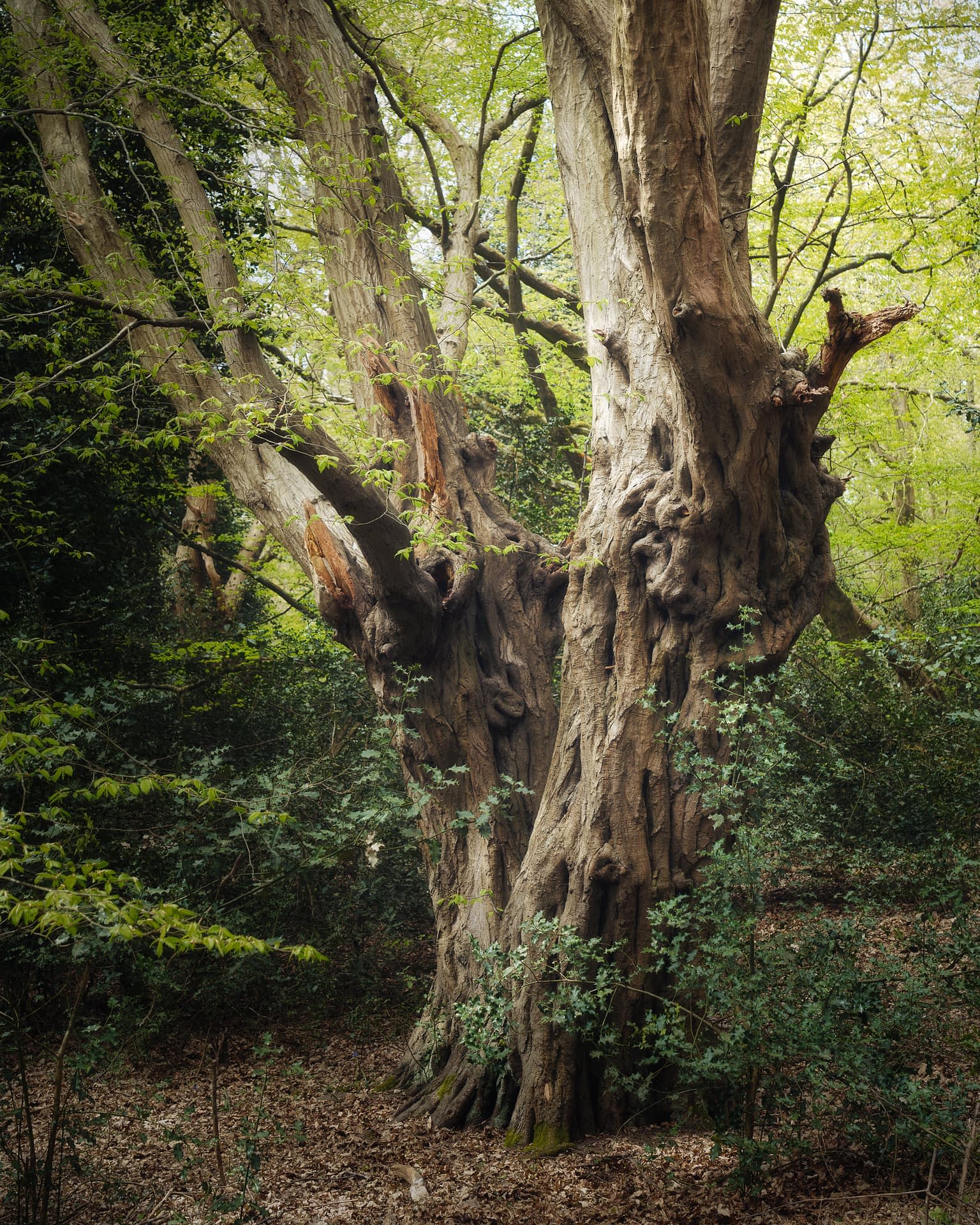
Centuries of pollarding made these forms. There is a body of work in the trunks alone.
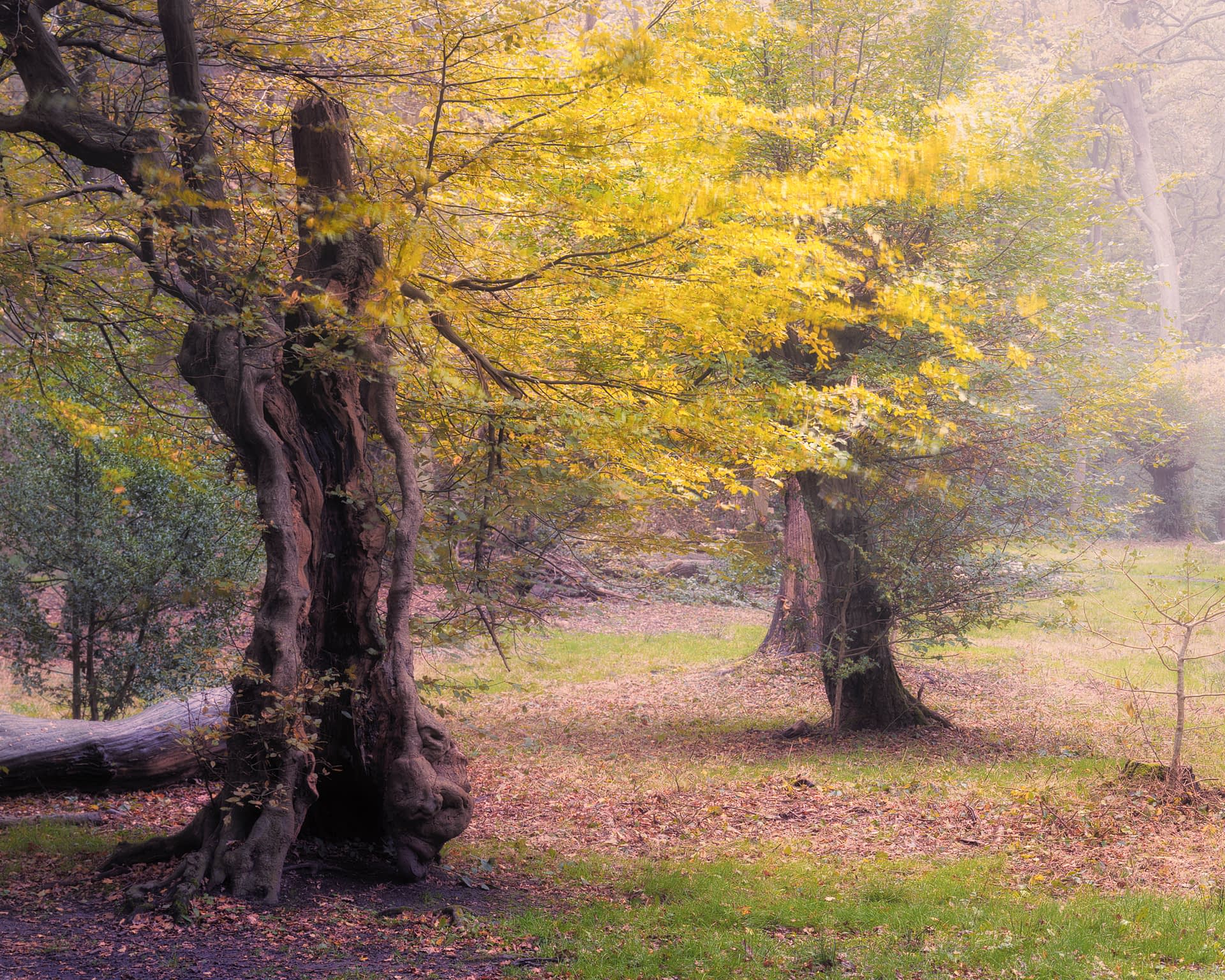
Early November, when the hornbeam canopies turn yellow. The colour holds, but the thinning canopy lets the sky in.
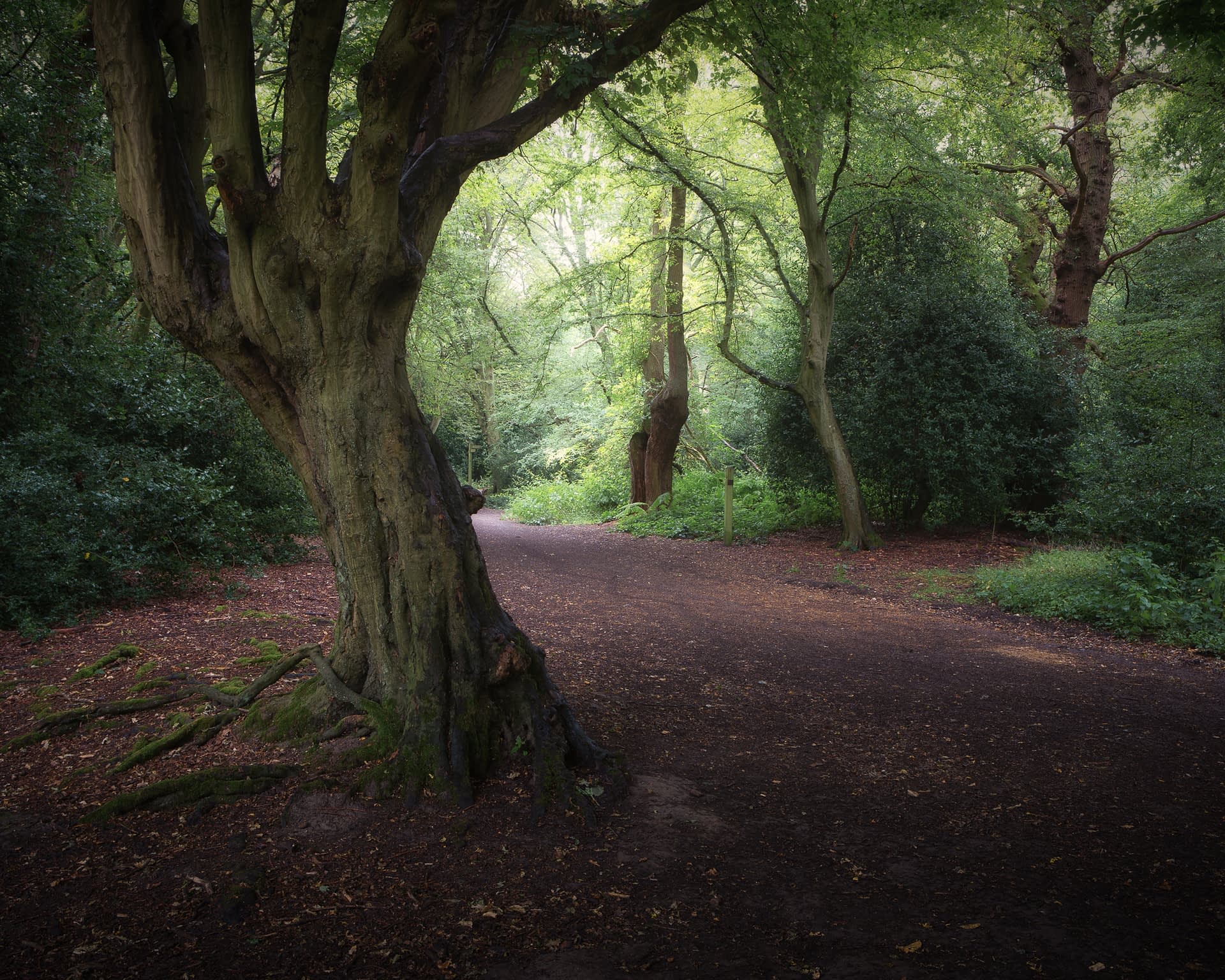
Along one of the main rides. Shooting along them, rather than across the wood, keeps a clean background on this flat site.
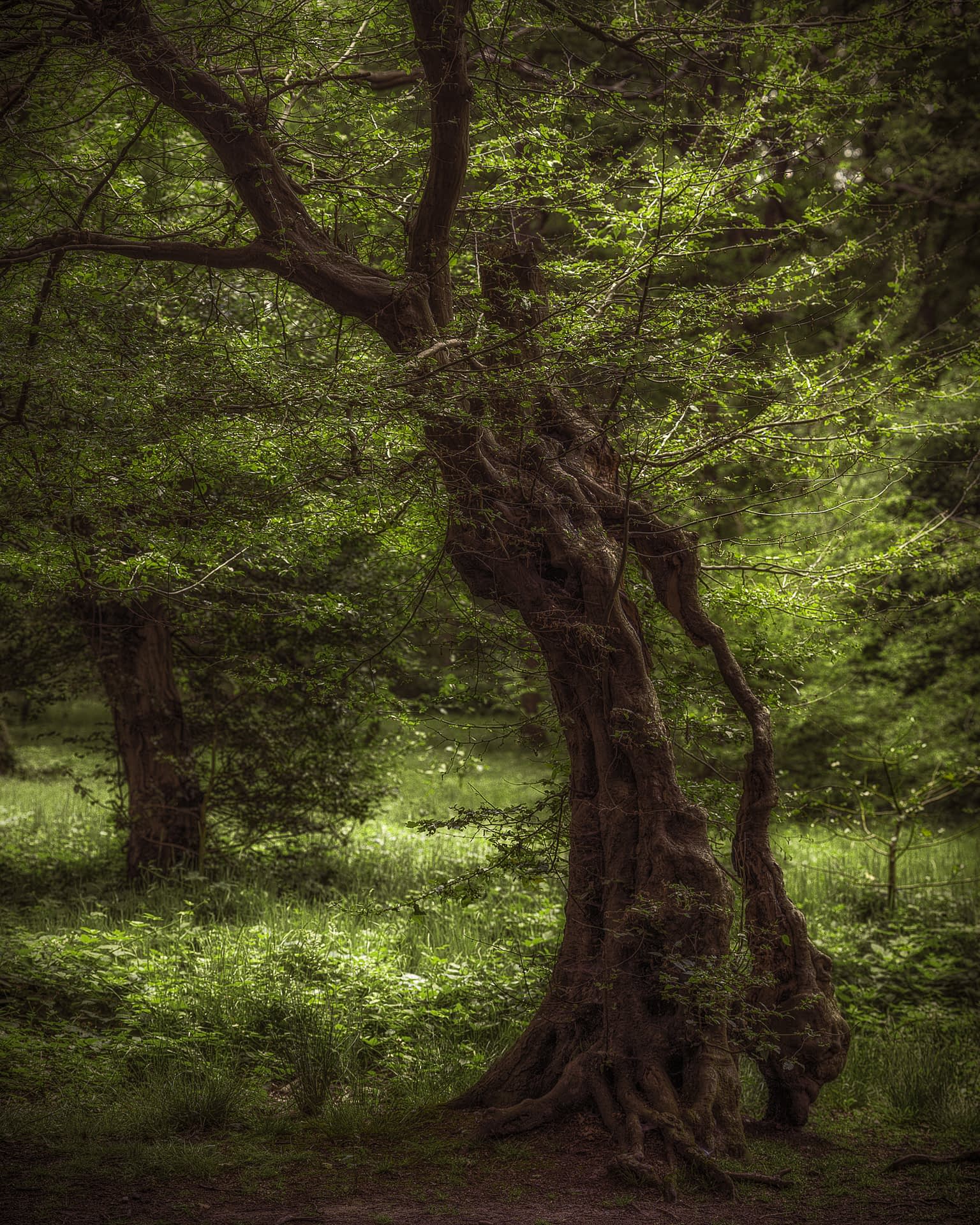
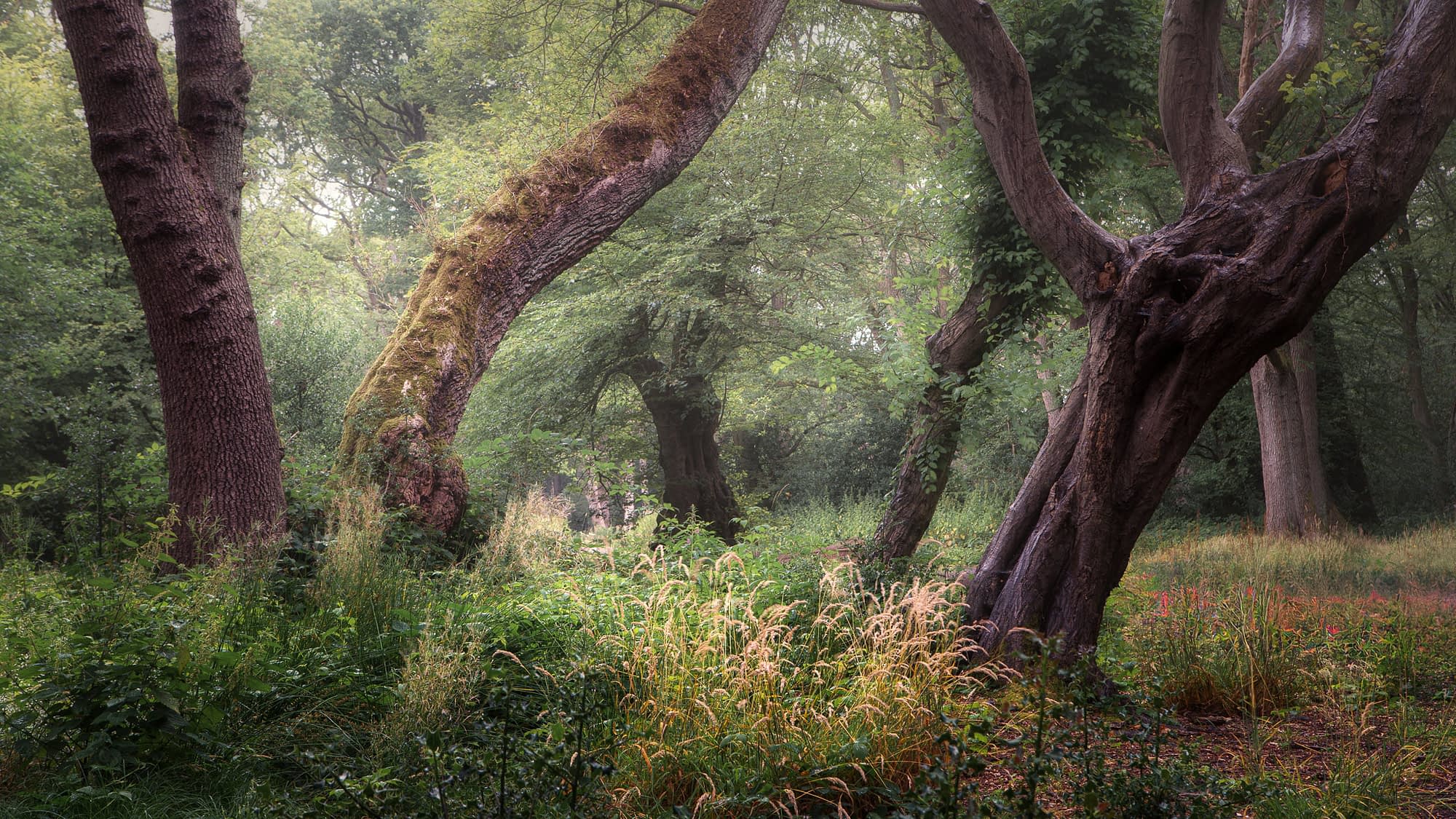
The wood pasture, where the trees stand with space around them. Every pollard here is a portrait waiting for the right weather.
Before you go
Visiting and shooting.
Getting there and parking.
I use both main car parks. Chigwell Row (IG7 6EZ) puts you into the Woodland Trust side quickly. Manor Road sits opposite the Miller and Carter steakhouse (RM4 1NH will get you there) and works well for the circular walk described further down.
Both car parks are gated, and the gates open at 8am. Sunrise is earlier than that for most of the year, which matters for woodland photography. The answer is the street parking near Chigwell Row, on Millers Lane and Coopers Close. Park considerately and you can be in the wood for first light in any season.
By public transport, Hainault and Grange Hill stations on the Central Line (London Underground) are close to the forest edges. I have not walked in from the stations myself, but it should be workable: you would enter from the Romford Road side, and you should allow for a long walk if you want the more remote parts of the wood.
Access and restrictions.
Access is open and has not changed meaningfully in the seven years I have known the place.
The one thing I would ask of any photographer here concerns the ancient trees themselves. Do not spend long pressed up close to them. Repeated footfall compacts the soil over their roots, and these trees are fragile ecosystems that have stood for centuries. Make your photograph and step back. For the same reason, this guide describes the remote trees but does not map them.
Best conditions and timing.
Hainault is at its best in rain. That is not a consolation prize; it is the recommendation. The colour deepens, the trunks darken, the crowds disappear, and the wood becomes the version of itself I go back for. Expect real mud when it is wet.
Fog here is fleeting. It arrives, and then it burns off quickly, so be ready for crepuscular rays and fast-moving light rather than a long, calm session. If you want to work in fog, work fast. It holds longer near the lake, although in my experience the photographic opportunities around the water are weaker than in the wood itself. I have written more about working in these conditions in my guide to photographing woodland in fog.
I have no fixed routine at Hainault. I visit when I visit, whatever the weather is doing, and change what I photograph to suit the conditions. Some visits are spent at areas I have mapped over the years; others are spent seeing what the established routes and the ground off them offer on the day. If the wider scenes are not working, the trunk detail and the forest floor usually are.
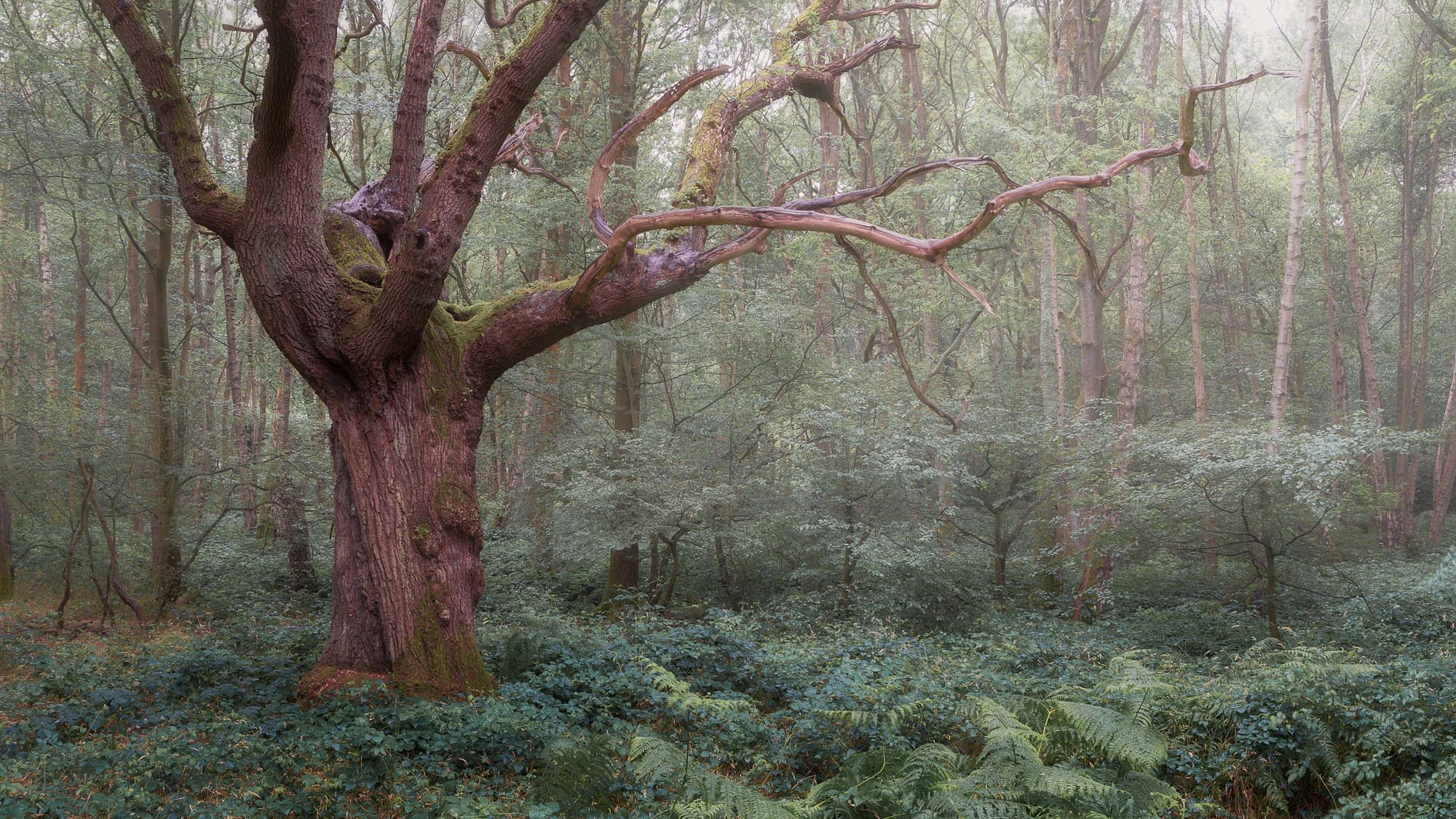
Rain does more for this wood than sun. One of the ancient oaks, on the kind of day most people drive home from.
Subjects and compositions
What to photograph.
The hornbeam pollards. These are the reason to come. Both individual portraits and small groups work. The main compositional challenge is the sky: there is little elevation change across the wood, so you cannot shoot down a slope to keep a clean background, and bright sky burning through the canopy will undo an otherwise good frame. Work with a longer focal length, shoot along the rides rather than across them, and use weather. This problem gets harder in late autumn as the canopy thins, which is exactly when the colour peaks, and it is why I am usually praying for fog or low cloud in November.
Trunk detail on the ancient trees. There is a body of work to be made in the character and shapes of the trunks of Hainault's ancient and veteran trees alone. Centuries of pollarding, weather and decay have left surfaces that reward a longer lens and patience. If you only have an hour and flat light, this is where I would spend it.
Fungi. From late summer onwards there is a lot of fungi, across a rich variety of species. It is worth carrying a macro lens so that the day is not lost when conditions for wider woodland photography are poor.
Wildlife, in passing. If you are lucky you may see the lesser spotted woodpecker here, one of 158 bird species recorded in the forest, and woodcock live in the wood too. The country park side has a deer enclosure, which I mention for completeness rather than photograph myself. Hainault is also home to 11 of the UK's 18 bat species, including brown long-eared, Natterer's, Daubenton's, common pipistrelle and the rare Barbastelle; more on the bats in the wood pasture section below.
A note on management. The Woodland Trust has carried out a lot of management work in recent years, and some areas are less photogenic right now because of it. That is temporary. The work is being done for the long-term health of the wood, and those areas will come back.
Identification and character
Tree species.
Hornbeam. The signature tree of Hainault, most of them ancient pollards. Fluted, muscular trunks and low, knuckled crowns from centuries of cutting. They read best in soft light and rain, when the bark darkens and the form does the work. In autumn the canopies turn a wonderful yellow.
Oak. Some amazing ancient oaks stand here alongside the hornbeams, broader and more open in form. They make strong individual portraits where the pollards often work better in groups.
Beech. Present through the wood, with the smooth grey bark that holds low light well and gives you clean tonal surfaces the rougher species do not.
Rowan and field maple. Both here in smaller numbers. Worth knowing in autumn, when they add reds and golds a purely hornbeam palette lacks.
Timing
Seasonal highlights.
Winter. The pollards with their structure exposed. Bare, knotted forms, and the quietest the wood gets. It is well worth visiting if there is overnight frost or freezing fog.
Spring. Bud-burst on the hornbeams, and yes, there are bluebells, but they are difficult to find and I will be honest: there are better places to photograph bluebells than Hainault. If bluebells are the goal, my guide to the best bluebell woods in Hertfordshire is the place to start.
High summer. Full canopy and deep shade. The season I use for the rides, the wood pasture and the edges rather than the interior.
Autumn. The season Hainault is for. The hornbeam colour usually peaks in early November, and it holds reasonably well rather than stripping in one storm. When I am after a specific image I visit once or twice a week from the last week of October through to mid November. The thinning canopy brings the sky problem with it, so this is when low cloud and fog earn their keep. For more on reading the seasons generally, see the best time for woodland photography.
Late summer onwards. The fungi season, running under everything above.
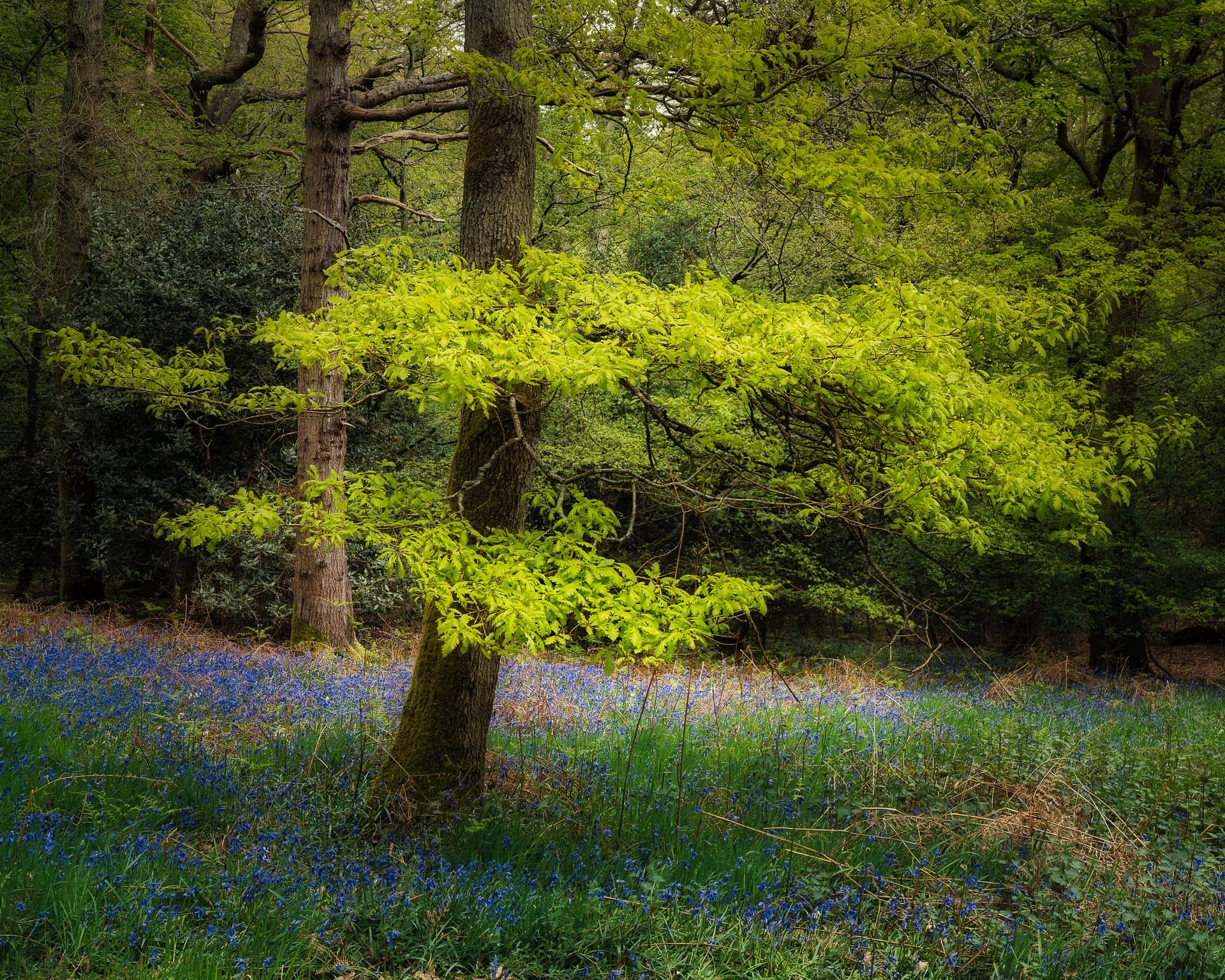
Spring
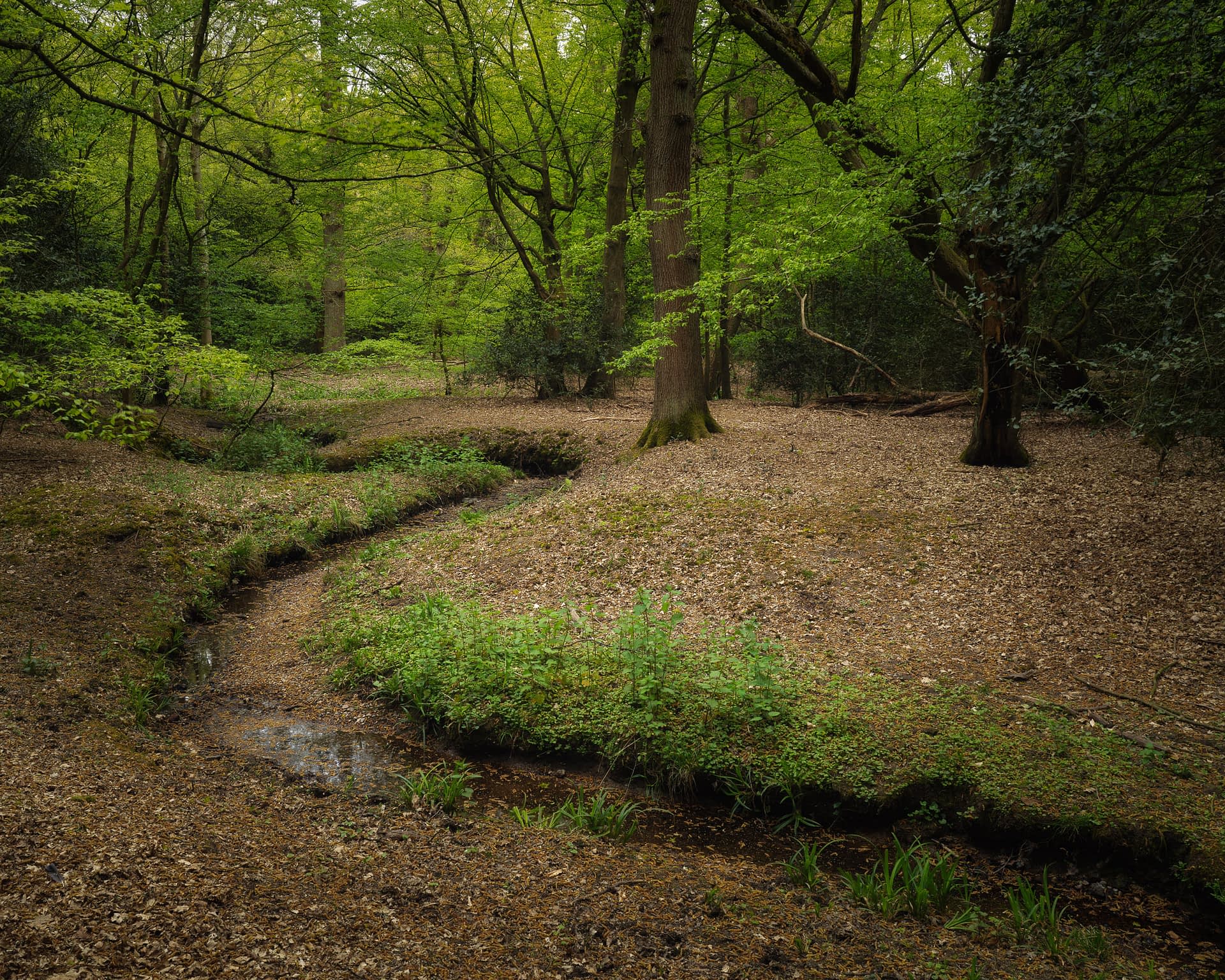
Summer
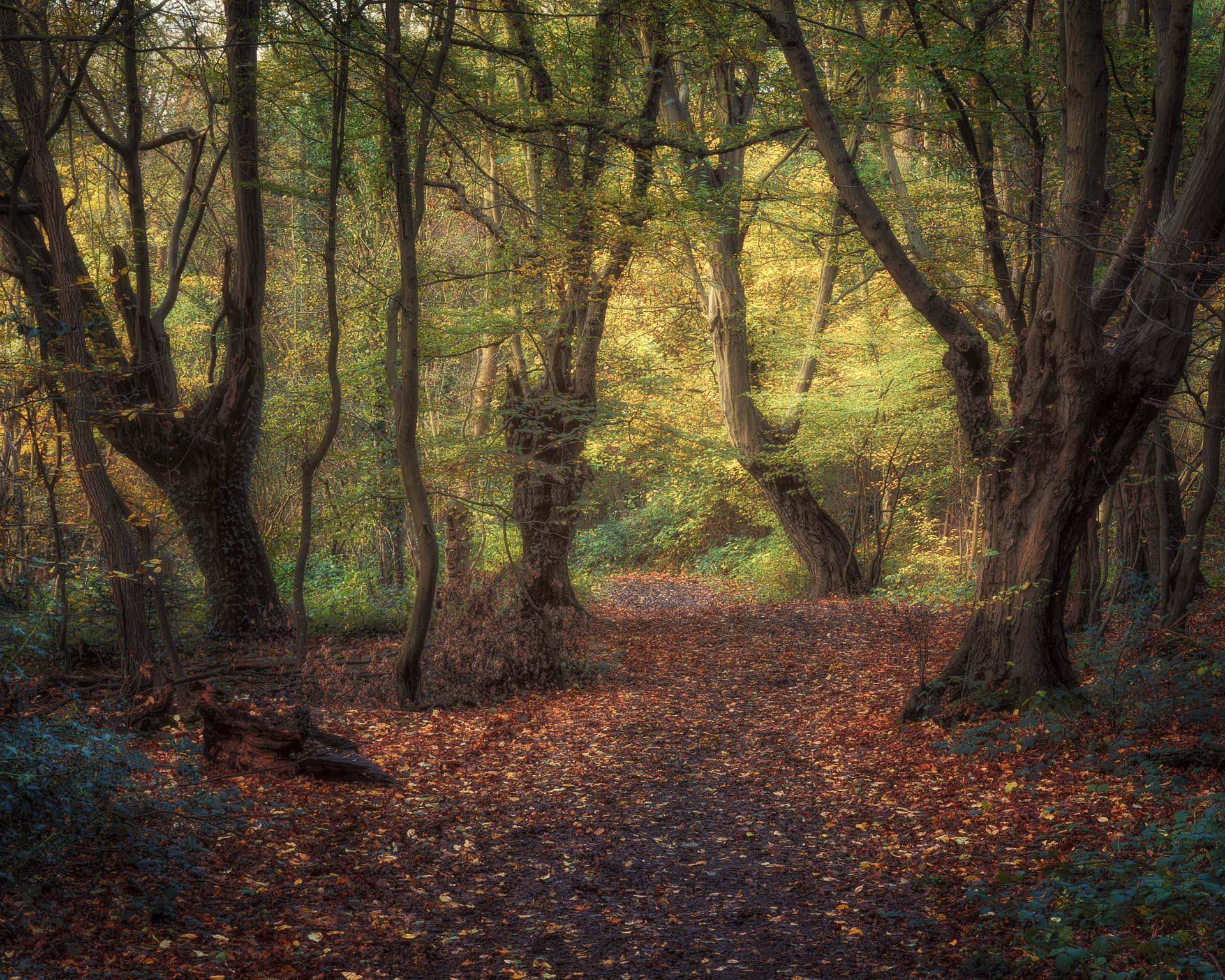
Autumn
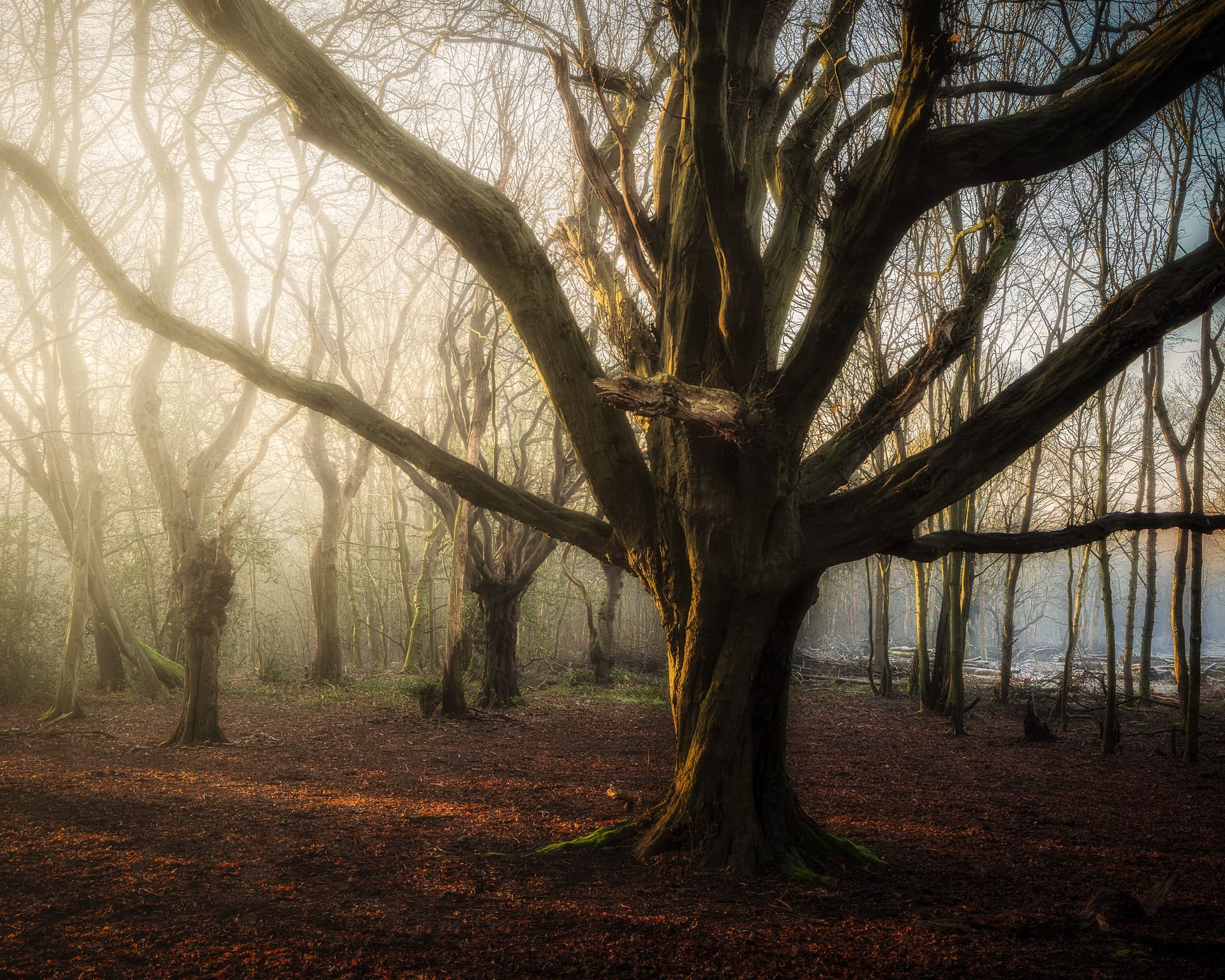
Winter
Four ways in
Areas to explore.
The ancient woodland trails.
Marked trails run through the ancient woodland and they are worth walking. The circuit I would point a first-time visitor to runs from Manor Road car park to Chigwell Row car park, into the woods and along the Essex border, where the Redbridge council land begins and the country park takes over, then back round to Manor Road along one of the main rides. There is a great deal to see on this loop, including some fine ancient trees, without any of the problems of the deeper wood.
CREATIVE TIP
Treat the border path as a portrait gallery. Walk it slowly with a short telephoto and work the individual trunks rather than the wider scenes.
mindful moment
Look for faces in the old trees along this stretch. Once you have found the first one, you will not stop finding them.
The remote north east.
A wider trail leads off into the more remote section in the north east of the wood. This is where Hainault feels least like the edge of London, and some of the most photographically interesting ancient trees are up here. Get your bearings in the rest of the wood before going off the paths in this area: the woodland becomes very dense and enclosed, with a lot of scrub between the more open areas, and it is genuinely easy to get lost. Phone signal is sparse up here too, which adds to the feeling of remoteness but means you should not count on your phone to find your way out. Download the OS map of the area in the OS Maps app before setting off, or carry a paper map.
CREATIVE TIP
Make the first visit a scouting walk. Note what you find and where, and come back for the photographs when you know the ground and the light.
mindful moment
Stand still up here for a minute and listen. It is hard to believe the London boundary is within walking distance.
The wood pasture and rides.
The more open parts of the wood, where trees stand with space around them. This is where a telephoto earns its place, compressing the pollards against the tree line and keeping the sky out of the frame on this flat site. The deer enclosure sits on the country park side if that interests you.
CREATIVE TIP
Shoot along the rides rather than across the pasture. The tree line becomes your background and the flat horizon stays out of the picture.
mindful moment
In summer, stay past sunset and watch the rides. Bats hunt along them in the last of the light, darting in and out of the tree line into twilight.
The lake.
On the country park side. In my experience the strongest thing the lake offers a woodland photographer is its weather: mist and fog hold longer over the water than in the wood. The pictures around the lake itself are weaker than in the woodland, and I treat it honestly as a secondary subject. That said, the fog and mist can sometimes drift into the trees near the lake, so it is worth investigating if you are drawing blanks elsewhere. When it happens, the light can be dramatic, and for a short while it turns this corner of the wood into something genuinely photogenic.
CREATIVE TIP
Use the lake as a barometer. If mist is sitting on the water at first light, move quickly, because whatever reaches the wood will not last long.
mindful moment
When the fog has already gone from the trees, it is often still moving on the water. Watch it go before you do.
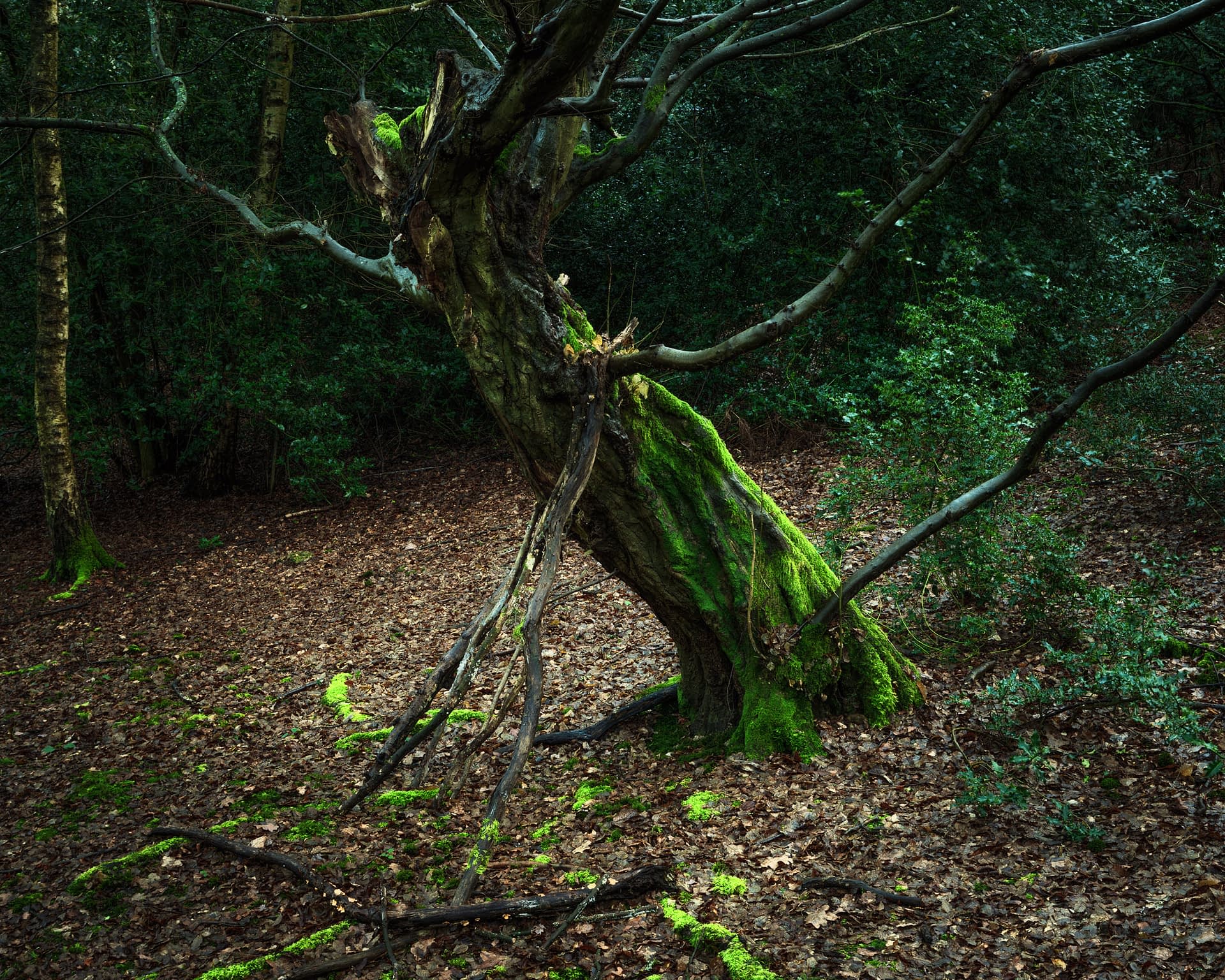
Deep in the north east section, where the wood closes in. Worth the effort of finding your way, and of knowing your way back.
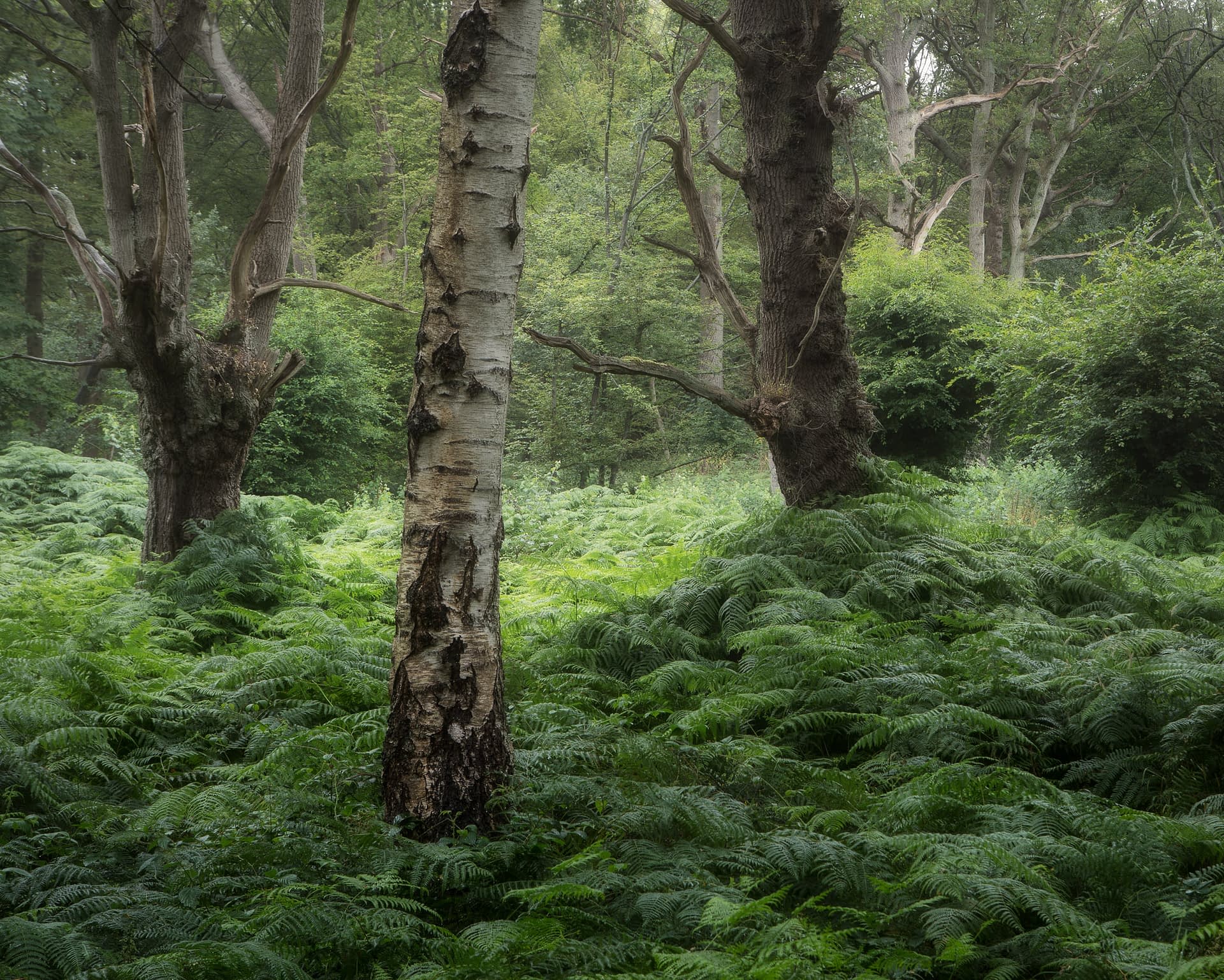
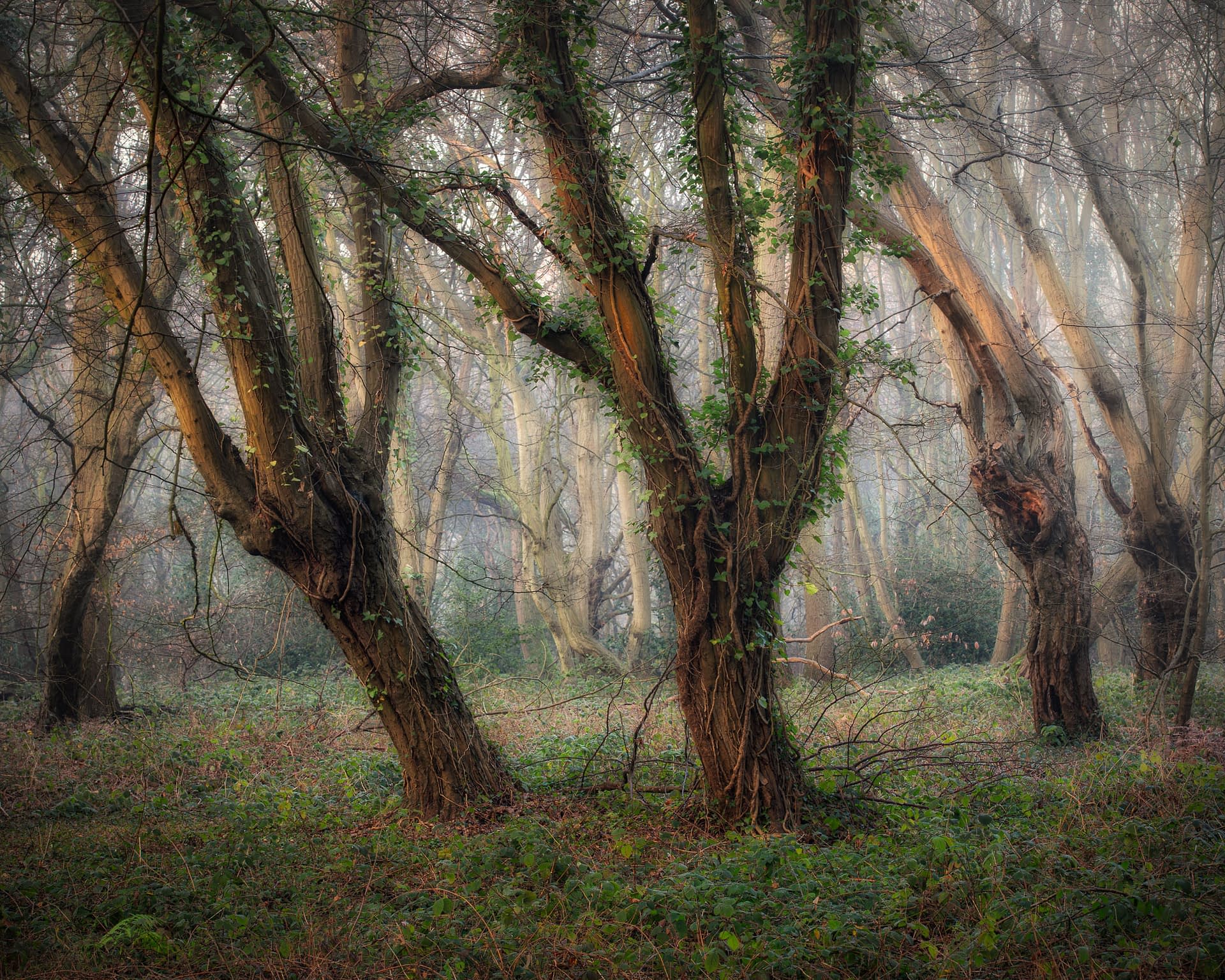
Not far from the lake, where the mist drifts into the trees. When this happens, drop whatever else you were doing.
Final thoughts
Hainault taught me something I now look for everywhere: the difference between visiting a wood and knowing one. Seven years in, I am still finding trees I have never photographed, still walking the border path and noticing a trunk I must have passed twenty times. A wood like this does not give you its best pictures on the first visit. It gives them to the photographer who comes back, in the rain, in the fog that will be gone in thirty minutes, in the first week of November when the hornbeams turn.
If this kind of woodland interests you, the story of what these places are and why so few survive is in What Is Ancient Woodland?, and the neighbouring guide to Epping Forest continues the history: it was Hainault's destruction that saved Epping.
Before you visit
Common questions about Hainault Forest.
Where do I park at Hainault Forest?
Chigwell Row car park (IG7 6EZ) or Manor Road car park (RM4 1NH is the postcode for the steakhouse opposite). The gates open at 8am, so for first light park on the street near Chigwell Row, on Millers Lane or Coopers Close.
When is the best time to photograph Hainault Forest?
Early November, when the hornbeam canopies turn yellow. The colour holds reasonably well, and the last week of October through to mid November is the window I work. In any season, the wood is at its best in rain.
What is Hainault Forest best known for photographically?
Its ancient hornbeam pollards, said to be one of the greatest concentrations in Europe, along with veteran oaks and a strong fungi season from late summer.
Can I get to Hainault Forest without a car?
Hainault and Grange Hill stations on the Central Line are close to the forest edges, entering from the Romford Road side. Allow for a long walk to reach the more remote parts of the wood.
Is Hainault Forest good for beginners?
Yes, if you stay on the marked trails, which pass some fine ancient trees. The remote north east is rewarding but dense, and it is easy to get lost, so learn the wood before going off the paths there.
Previous Guide
Next Guide
Free composition guide
Learn how to tame the chaos in the woods.
Woodland is the hardest landscape to compose. This free guide gives you a practical way to cut through the visual mess and find the picture, in Hainault or any wood you walk into.